Ch.15 - Chemical Equilibrium
Tro - Chemistry: A Molecular Approach 4th Edition
Tro4th EditionChemistry: A Molecular ApproachISBN: 9780134112831당신이 사용하는 게 아니라요?교과서 변경
15장, 문제 5

Nitrogen dioxide dimerizes according to the reaction: 2 NO2(g) ⇌ N2O4(g) Kp = 6.7 at 298 K. A 2.25-L container contains 0.055 mol of NO2 and 0.082 mol of N2O4 at 298 K. Is the reaction at equilibrium? If not, in which direction will the reaction proceed?

검증된 단계별 안내
1
Calculate the initial partial pressures of NO2 and N2O4 using the ideal gas law: P = (nRT)/V, where n is the number of moles, R is the ideal gas constant (0.0821 L·atm/mol·K), T is the temperature in Kelvin, and V is the volume of the container.
Determine the reaction quotient, Qp, using the expression Qp = (P_{N2O4}) / (P_{NO2})^2, where P_{N2O4} and P_{NO2} are the partial pressures of N2O4 and NO2, respectively.
Compare the calculated Qp to the given equilibrium constant Kp. If Qp < Kp, the reaction will proceed in the forward direction to reach equilibrium. If Qp > Kp, the reaction will proceed in the reverse direction. If Qp = Kp, the reaction is at equilibrium.
Analyze the direction of the reaction based on the comparison of Qp and Kp to determine if the reaction will shift towards the formation of more products (N2O4) or reactants (NO2).
Conclude whether the reaction is at equilibrium or predict the direction in which the reaction will proceed to reach equilibrium.

주요 개념

질문에 올바르게 답하기 위해 반드시 이해해야 하는 핵심 개념들은 다음과 같습니다.

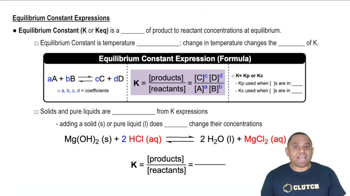
Equilibrium Constant (Kp)

The equilibrium constant (Kp) is a numerical value that expresses the ratio of the concentrations of products to reactants at equilibrium for a given reaction at a specific temperature. For the reaction 2 NO2(g) ⇌ N2O4(g), Kp = 6.7 indicates the extent to which the reaction favors the formation of products (N2O4) over reactants (NO2) at 298 K.
추천 영상:
가이드 코스
03:20
Equilibrium Constant Expressions

Reaction Quotient (Q)

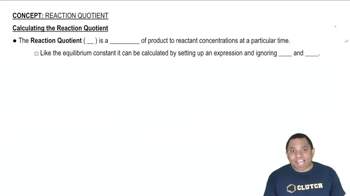
The reaction quotient (Q) is calculated using the current concentrations of the reactants and products in a system, similar to Kp but not necessarily at equilibrium. By comparing Q to Kp, one can determine the direction in which the reaction will shift to reach equilibrium. If Q < Kp, the reaction will proceed to the right (toward products); if Q > Kp, it will shift to the left (toward reactants).
추천 영상:
가이드 코스
00:49
Reaction Quotient Q

Calculating Concentrations

To determine if the reaction is at equilibrium, one must calculate the concentrations of NO2 and N2O4 in the 2.25-L container. Concentration is found by dividing the number of moles by the volume of the container. This allows for the calculation of Q, which can then be compared to Kp to assess the state of the reaction.
추천 영상:
가이드 코스
07:35
Calculate Concentration of the Basic Form