Determine whether or not each metal dissolves in 1 M HNO3. For those metals that do dissolve, write a balanced redox reaction showing what happens when the metal dissolves. a. Cu b. Au
Ch.19 - Electrochemistry
19장, 문제 58
Determine whether or not each metal dissolves in 1 M HCl. For those metals that do dissolve, write a balanced redox reaction showing what happens when the metal dissolves. a. Cu b. Fe c. Au
검증된 단계별 안내1
Step 1: Understand the reactivity series of metals. Metals that are above hydrogen in the reactivity series can displace hydrogen from acids like HCl, leading to dissolution.
Step 2: Identify the position of each metal (Cu, Fe, Au) in the reactivity series. Copper (Cu) and gold (Au) are below hydrogen, while iron (Fe) is above hydrogen.
Step 3: Determine which metals will dissolve in 1 M HCl. Since Fe is above hydrogen, it will dissolve in HCl, while Cu and Au will not.
Step 4: Write the balanced redox reaction for the metal that dissolves. For Fe, the reaction is: \[ \text{Fe (s)} + 2\text{HCl (aq)} \rightarrow \text{FeCl}_2\text{(aq)} + \text{H}_2\text{(g)} \].
Step 5: Verify the redox reaction by checking the oxidation states. Fe goes from 0 to +2 (oxidation), and H goes from +1 to 0 (reduction), confirming the redox process.

비슷한 문제에 대한 검증된 영상 답변:
이 영상 해법은 위 문제에 도움이 된다고 튜터들이 추천한 것입니다.
영상 길이:
3m도움이 되었나요?
주요 개념
질문에 올바르게 답하기 위해 반드시 이해해야 하는 핵심 개념들은 다음과 같습니다.
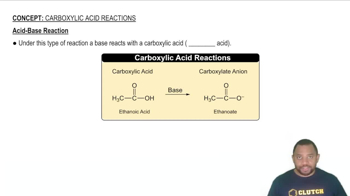
Acid-Base Reactions
Acid-base reactions involve the transfer of protons (H+) between reactants. In this context, hydrochloric acid (HCl) acts as a strong acid that can donate protons. Understanding how metals interact with acids is crucial for predicting whether a metal will dissolve in HCl, as some metals can displace hydrogen ions from the acid.
추천 영상:
가이드 코스
Acid-Base Reaction
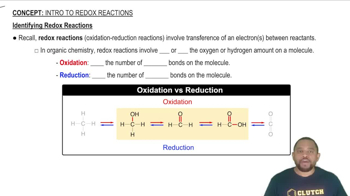
Redox Reactions
Redox (reduction-oxidation) reactions involve the transfer of electrons between substances, leading to changes in oxidation states. When a metal dissolves in an acid, it typically undergoes oxidation, losing electrons, while the hydrogen ions in the acid are reduced to hydrogen gas. Balancing these reactions requires understanding the electron transfer process and the oxidation states of the involved species.
추천 영상:
가이드 코스
Identifying Redox Reactions
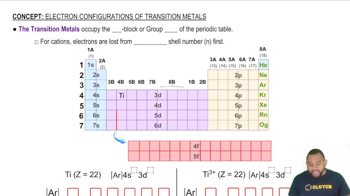
Reactivity of Metals
The reactivity of metals determines their ability to dissolve in acids. Metals like iron (Fe) are more reactive and can displace hydrogen from acids, while less reactive metals like copper (Cu) and gold (Au) do not react with HCl. Knowing the reactivity series helps predict which metals will dissolve in HCl and allows for the formulation of balanced chemical equations for the reactions.
추천 영상:
가이드 코스
Transition Metals
관련 실천
교과서 질문
1263
views
1
rank
교과서 질문
Determine whether or not each metal dissolves in 1 M HCl. For those metals that do dissolve, write a balanced redox reaction showing what happens when the metal dissolves. a. Al b. Ag c. Pb
3515
views
6
rank
교과서 질문
Which metal could you use to reduce Mn2+ ions but not Mg2+ ions?
1002
views
교과서 질문
Which metal can be oxidized with an Sn2+ solution but not with an Fe2+ solution?
648
views
교과서 질문
Determine whether or not each metal dissolves in 1 M HIO3. For those metals that do dissolve, write a balanced redox equation for the reaction that occurs. a. Au b. Cr
1250
views
교과서 질문
Calculate E°cell for each balanced redox reaction and determine if the reaction is spontaneous as written. a. 2 Cu(s) + Mn2+(aq) → 2 Cu+(aq) + Mn(s)
1221
views