Ch.6 - Thermochemistry
Tro - Chemistry: A Molecular Approach 4th Edition
Tro4th EditionChemistry: A Molecular ApproachISBN: 9780134112831당신이 사용하는 게 아니라요?교과서 변경
6장, 문제 39a

Identify each energy exchange as primarily heat or work and determine whether the sign of ΔE is positive or negative for the system. a. Sweat evaporates from skin, cooling the skin. (The evaporating sweat is the system.)

검증된 단계별 안내
1
Identify the type of process: Evaporation of sweat is an endothermic process, meaning the system (sweat) absorbs heat from the surroundings (skin).
Determine the type of energy exchange: Since the system absorbs heat, the primary energy exchange is heat.
Assess the direction of heat flow: Heat flows into the system (sweat) from the surroundings (skin), indicating that heat is absorbed by the system.
Determine the sign of ΔE (change in internal energy) for the system: When a system absorbs heat, the internal energy of the system increases, so ΔE is positive.
Conclude the energy exchange and sign of ΔE: The energy exchange is primarily heat, and the sign of ΔE for the system is positive.

비슷한 문제에 대한 검증된 영상 답변:

이 영상 해법은 위 문제에 도움이 된다고 튜터들이 추천한 것입니다.
영상 길이:
3m
도움이 되었나요?

주요 개념

질문에 올바르게 답하기 위해 반드시 이해해야 하는 핵심 개념들은 다음과 같습니다.

Energy Exchange

Energy exchange in thermodynamics refers to the transfer of energy between a system and its surroundings. This can occur in the form of heat, which is energy transferred due to temperature differences, or work, which is energy transferred when a force is applied over a distance. Understanding how energy is exchanged is crucial for analyzing changes in a system's internal energy.
추천 영상:
가이드 코스
01:26
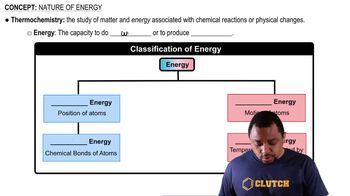
Nature of Energy

Heat Transfer

Heat transfer is the process by which thermal energy moves from one object or system to another due to a temperature difference. In the context of the question, the evaporation of sweat from the skin represents a cooling effect, indicating that heat is leaving the system (the skin) to facilitate the phase change of sweat from liquid to vapor. This process is essential for regulating body temperature.
추천 영상:

Change in Internal Energy (ΔE)

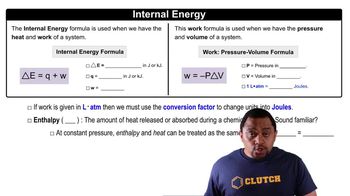
The change in internal energy (ΔE) of a system is defined as the total energy change resulting from heat and work interactions. According to the first law of thermodynamics, ΔE = q + w, where q is heat added to the system and w is work done on the system. In the case of evaporating sweat, heat is lost, leading to a negative ΔE for the system, indicating a decrease in internal energy.
추천 영상:
가이드 코스
01:51
Internal Energy
관련 실천
교과서 질문

A system releases 622 kJ of heat and does 105 kJ of work on the surroundings. What is the change in internal energy of the system?

2300
views

교과서 질문

Identify each energy exchange as primarily heat or work and determine whether the sign of ΔE is positive or negative for the system. Identify each energy exchange as primarily heat or work. a. A rolling billiard ball collides with another billiard ball. The first billiard ball (defined as the system) stops rolling after the collision. b. A book falls to the floor. (The book is the system). c. A father pushes his daughter on a swing. (The daughter and the swing are the system). Identify each energy exchange as primarily heat or work.

916
views
교과서 질문

Identify each energy exchange as primarily heat or work and determine whether the sign of ΔE is positive or negative for the system. a. Sweat evaporates from skin, cooling the skin. (The evaporating sweat is the system.) b. A balloon expands against an external pressure. (The contents of the balloon is the system.) c. An aqueous chemical reaction mixture is warmed with an external flame. (The reaction mixture is the system.) Identify energy exchanges as primarily heat or work. Determine whether the sign of E is positive or negative for the system.

1287
views
교과서 질문

A particular frost-free refrigerator uses about 745 kWh of electrical energy per year. Express this amount of energy in each unit. c. Cal

757
views
교과서 질문

Which statement is true of the internal energy of a system and its surroundings during an energy exchange with a negative ΔEsys? a. The internal energy of the system increases and the internal energy of the surroundings decreases. b. The internal energy of both the system and the surroundings increases. c. The internal energy of both the system and the surroundings decreases. d. The internal energy of the system decreases and the internal energy of the surroundings increases.

2278
views
1
comments