Ch.10 - Chemical Bonding II: Molecular Shapes & Valence Bond Theory
Tro - Chemistry: A Molecular Approach 4th Edition
Tro4th EditionChemistry: A Molecular ApproachISBN: 9780134112831당신이 사용하는 게 아니라요?교과서 변경
10장, 문제 78

Apply molecular orbital theory to predict if each molecule or ion exists in a relatively stable form. a. C22+ b. Li2 c. Be22+ d. Li22-

검증된 단계별 안내
1
Identify the total number of electrons in each molecule or ion. For example, C2^2+ has two carbon atoms (each with 6 electrons) minus 2 electrons due to the charge, giving a total of 10 electrons.
Draw the molecular orbital (MO) diagram for each molecule or ion. Start by arranging the atomic orbitals (s and p orbitals) and then combine them to form bonding and antibonding molecular orbitals.
Fill the molecular orbitals with the total number of electrons calculated in step 1, following Hund's rule and the Pauli exclusion principle. Electrons fill the lowest energy orbitals first.
Determine the bond order for each molecule or ion using the formula: Bond Order = (Number of electrons in bonding orbitals - Number of electrons in antibonding orbitals) / 2.
Assess the stability of each molecule or ion based on the bond order. A positive bond order suggests a stable molecule, whereas a bond order of zero or negative indicates instability.

비슷한 문제에 대한 검증된 영상 답변:

이 영상 해법은 위 문제에 도움이 된다고 튜터들이 추천한 것입니다.
영상 길이:
8m

주요 개념

질문에 올바르게 답하기 위해 반드시 이해해야 하는 핵심 개념들은 다음과 같습니다.

Molecular Orbital Theory

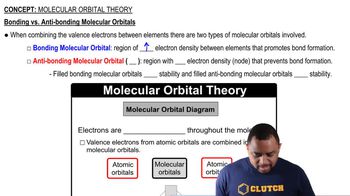
Molecular Orbital Theory (MOT) describes the behavior of electrons in molecules by combining atomic orbitals to form molecular orbitals. These orbitals can be bonding, antibonding, or non-bonding, and the distribution of electrons among them determines the stability and properties of the molecule. Understanding MOT is crucial for predicting the existence and stability of molecules and ions.
추천 영상:
가이드 코스
03:06
Molecular Orbital Theory

Bond Order

Bond order is a measure of the number of chemical bonds between a pair of atoms, calculated as the difference between the number of bonding and antibonding electrons divided by two. A higher bond order indicates a more stable molecule, while a bond order of zero suggests that the molecule is unstable and unlikely to exist. Evaluating bond order helps in assessing the stability of the given species.
추천 영상:
가이드 코스
00:36
Average Bond Order

Electron Configuration in Ions

The electron configuration of ions is essential for understanding their stability. When atoms gain or lose electrons to form ions, their electron configurations change, affecting their molecular orbital filling. For example, cations have fewer electrons, which can lead to higher bond orders, while anions have additional electrons, potentially lowering stability. Analyzing the electron configurations of the given ions is key to predicting their stability.
추천 영상:
가이드 코스
00:35
Anion Electron Configuration