Ch.10 - Chemical Bonding II: Molecular Shapes & Valence Bond Theory
Tro - Chemistry: A Molecular Approach 4th Edition
Tro4th EditionChemistry: A Molecular ApproachISBN: 9780134112831당신이 사용하는 게 아니라요?교과서 변경
10장, 문제 93

Can you provide the formulas of the compounds or ions that bromine forms with one to five fluorine atoms, assign a hybridization to each, and describe their electron and molecular geometry?

검증된 단계별 안내
1
Identify the possible compounds or ions that bromine can form with one to five fluorine atoms: BrF, BrF_2^-, BrF_3, BrF_4^-, and BrF_5.
For each compound or ion, determine the number of electron domains around the central bromine atom, which includes both bonding pairs and lone pairs.
Assign the hybridization based on the number of electron domains: sp^3d for 5 domains, sp^3d^2 for 6 domains, etc.
Determine the electron geometry using the VSEPR theory: linear, trigonal bipyramidal, octahedral, etc., based on the number of electron domains.
Describe the molecular geometry by considering the arrangement of atoms, ignoring lone pairs: linear, T-shaped, see-saw, square planar, etc.

주요 개념

질문에 올바르게 답하기 위해 반드시 이해해야 하는 핵심 개념들은 다음과 같습니다.

Bromine and Fluorine Compounds

Bromine (Br) can form several compounds with fluorine (F) by sharing electrons, resulting in various bromine fluorides. The most common compounds include BrF, BrF2, BrF3, BrF4, and BrF5, each differing in the number of fluorine atoms bonded to bromine. Understanding these compounds requires knowledge of their molecular formulas and the nature of the bonds formed.
추천 영상:
가이드 코스
00:59
Noble Gas Compounds

Hybridization

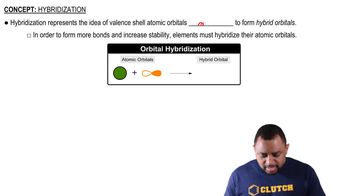
Hybridization is the concept of mixing atomic orbitals to form new hybrid orbitals that can accommodate bonding. For bromine compounds with fluorine, the hybridization can vary: BrF has sp3 hybridization, BrF2 is sp3d, BrF3 is sp3d2, BrF4 is sp3d3, and BrF5 is sp3d3. This hybridization determines the geometry and bond angles of the molecules.
추천 영상:

Molecular Geometry

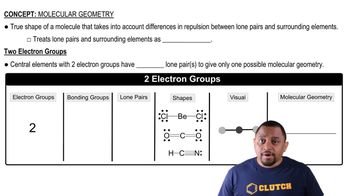
Molecular geometry refers to the three-dimensional arrangement of atoms in a molecule, which is influenced by the number of bonding pairs and lone pairs of electrons. For example, BrF has a linear geometry, BrF2 is bent, BrF3 has a T-shaped geometry, BrF4 is square planar, and BrF5 adopts a trigonal bipyramidal shape. Understanding these geometries helps predict the physical and chemical properties of the compounds.
추천 영상:
가이드 코스
01:33
Molecular Geometry with Two Electron Groups