

Ch.10 - Chemical Bonding II: Molecular Shapes & Valence Bond Theory
Tro - Chemistry: A Molecular Approach 4th Edition
Tro4th EditionChemistry: A Molecular ApproachISBN: 9780134112831당신이 사용하는 게 아니라요?교과서 변경
10장, 문제 91

Draw a molecular orbital energy diagram for ClF. (Assume that the sp orbitals are lower in energy than the p orbitals.) What is the bond order in ClF?

검증된 단계별 안내
1
Identify the atomic orbitals involved: Chlorine (Cl) and Fluorine (F) both have valence electrons in the 3p and 2p orbitals, respectively.
Construct the molecular orbital (MO) diagram: Start by placing the atomic orbitals of Cl and F on either side of the diagram. Since Cl is less electronegative than F, its atomic orbitals will be slightly higher in energy.
Combine the atomic orbitals to form molecular orbitals: The 3s and 2s orbitals will combine to form σ and σ* molecular orbitals. The 3p and 2p orbitals will combine to form σ, π, π*, and σ* molecular orbitals.
Fill the molecular orbitals with electrons: ClF has a total of 14 valence electrons. Fill the molecular orbitals starting from the lowest energy level, following the Pauli exclusion principle and Hund's rule.
Calculate the bond order: Use the formula \( \text{Bond Order} = \frac{(\text{Number of electrons in bonding MOs} - \text{Number of electrons in antibonding MOs})}{2} \) to determine the bond order of ClF.

비슷한 문제에 대한 검증된 영상 답변:

이 영상 해법은 위 문제에 도움이 된다고 튜터들이 추천한 것입니다.
영상 길이:
6m

주요 개념

질문에 올바르게 답하기 위해 반드시 이해해야 하는 핵심 개념들은 다음과 같습니다.

Molecular Orbital Theory

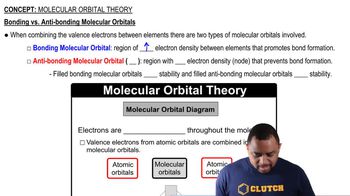
Molecular Orbital Theory describes how atomic orbitals combine to form molecular orbitals, which can be occupied by electrons. In this theory, electrons are delocalized over the entire molecule rather than being confined to individual atoms. The energy levels of these molecular orbitals are determined by the energies of the atomic orbitals involved in their formation, influencing the stability and reactivity of the molecule.
추천 영상:
가이드 코스
03:06
Molecular Orbital Theory

Bond Order

Bond order is a measure of the number of chemical bonds between a pair of atoms. It is calculated as the difference between the number of bonding and antibonding electrons divided by two. A higher bond order indicates a stronger bond and greater stability of the molecule. In the case of ClF, determining the bond order involves analyzing the molecular orbital diagram to count the electrons in bonding and antibonding orbitals.
추천 영상:
가이드 코스
00:36
Average Bond Order

Energy Levels of Orbitals

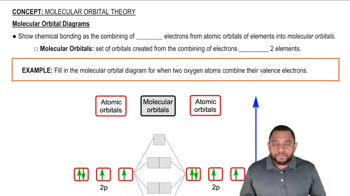
The energy levels of atomic and molecular orbitals dictate how electrons are arranged in a molecule. In ClF, it is assumed that sp orbitals are lower in energy than p orbitals, which affects the arrangement of electrons in the molecular orbital diagram. Understanding these energy levels is crucial for predicting the stability and bond characteristics of the molecule, as they influence the filling of molecular orbitals and the resulting bond order.
추천 영상:
가이드 코스
04:12
Molecular Orbital Diagram
관련 실천