Ch.11 - Liquids, Solids & Intermolecular Forces
Tro - Chemistry: A Molecular Approach 4th Edition
Tro4th EditionChemistry: A Molecular ApproachISBN: 9780134112831당신이 사용하는 게 아니라요?교과서 변경
11장, 문제 42a,c

In each pair of compounds, pick the one with the higher boiling point. Explain your reasoning. a. NH3 or CH4 c. CO2 or NO2

검증된 단계별 안내
1
Identify the type of intermolecular forces present in each compound. NH_3 has hydrogen bonding due to the N-H bond, while CH_4 has only London dispersion forces.
Compare the strength of intermolecular forces: Hydrogen bonds in NH_3 are stronger than the London dispersion forces in CH_4, leading to a higher boiling point for NH_3.
For CO_2 and NO_2, identify the molecular geometry and polarity. CO_2 is linear and nonpolar, while NO_2 is bent and polar.
Determine the types of intermolecular forces: CO_2 has London dispersion forces, whereas NO_2 has both dipole-dipole interactions and London dispersion forces.
Compare the strength of intermolecular forces: The presence of dipole-dipole interactions in NO_2 makes its intermolecular forces stronger than those in CO_2, resulting in a higher boiling point for NO_2.

비슷한 문제에 대한 검증된 영상 답변:

이 영상 해법은 위 문제에 도움이 된다고 튜터들이 추천한 것입니다.
영상 길이:
3m
도움이 되었나요?

주요 개념

질문에 올바르게 답하기 위해 반드시 이해해야 하는 핵심 개념들은 다음과 같습니다.

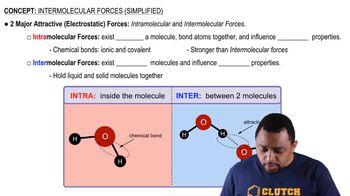
Intermolecular Forces

Intermolecular forces are the attractive forces between molecules that influence physical properties like boiling points. Stronger intermolecular forces, such as hydrogen bonding or dipole-dipole interactions, typically result in higher boiling points. For example, ammonia (NH3) exhibits hydrogen bonding, while methane (CH4) has weaker London dispersion forces.
추천 영상:
가이드 코스
01:59
Intermolecular vs Intramolecular Forces

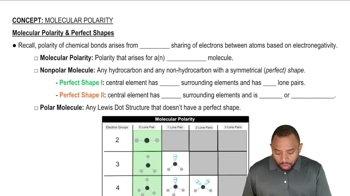
Molecular Polarity

Molecular polarity refers to the distribution of electrical charge across a molecule, which affects its interactions with other molecules. Polar molecules, which have a significant difference in electronegativity between atoms, tend to have higher boiling points due to stronger dipole-dipole interactions. In contrast, nonpolar molecules like carbon dioxide (CO2) do not exhibit such strong interactions.
추천 영상:
가이드 코스
02:38
Molecular Polarity

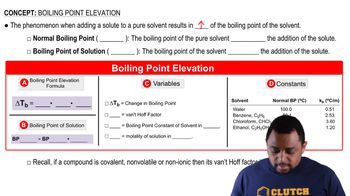
Boiling Point Trends

Boiling point trends can be understood by examining the types of intermolecular forces present and the molecular structure. Generally, compounds with stronger intermolecular forces and higher molecular weights have higher boiling points. For instance, comparing nitrogen dioxide (NO2) and carbon dioxide (CO2), NO2 is polar and has stronger interactions, leading to a higher boiling point.
추천 영상:
가이드 코스
03:05
Boiling Point Elevation