Ch.11 - Liquids, Solids & Intermolecular Forces
Tro - Chemistry: A Molecular Approach 4th Edition
Tro4th EditionChemistry: A Molecular ApproachISBN: 9780134112831당신이 사용하는 게 아니라요?교과서 변경
11장, 문제 42b

In each pair of compounds, pick the one with the higher boiling point. Explain your reasoning. b. CS2 or CO2

검증된 단계별 안내
1
Identify the type of intermolecular forces present in each compound. CS_2 and CO_2 are both nonpolar molecules, so they primarily exhibit London dispersion forces.
Consider the molecular weights of the compounds. CS_2 has a higher molecular weight than CO_2, which generally leads to stronger London dispersion forces.
Analyze the molecular shape and symmetry. CO_2 is a linear molecule, while CS_2 is also linear, but the larger size of sulfur compared to oxygen can affect the strength of dispersion forces.
Evaluate the polarizability of the molecules. Larger atoms like sulfur in CS_2 are more polarizable than smaller atoms like oxygen in CO_2, leading to stronger dispersion forces in CS_2.
Conclude that the compound with stronger intermolecular forces will have a higher boiling point. Since CS_2 has stronger London dispersion forces due to its higher molecular weight and greater polarizability, it will have a higher boiling point than CO_2.

비슷한 문제에 대한 검증된 영상 답변:

이 영상 해법은 위 문제에 도움이 된다고 튜터들이 추천한 것입니다.
영상 길이:
1m
도움이 되었나요?

주요 개념

질문에 올바르게 답하기 위해 반드시 이해해야 하는 핵심 개념들은 다음과 같습니다.

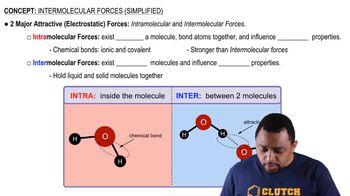
Intermolecular Forces

Intermolecular forces are the attractive forces between molecules that influence physical properties like boiling points. The main types include hydrogen bonding, dipole-dipole interactions, and London dispersion forces. Stronger intermolecular forces typically result in higher boiling points, as more energy is required to separate the molecules.
추천 영상:
가이드 코스
01:59
Intermolecular vs Intramolecular Forces

Molecular Structure and Polarity

The molecular structure and polarity of a compound significantly affect its boiling point. Polar molecules, which have a positive and negative end due to uneven electron distribution, generally exhibit stronger dipole-dipole interactions compared to nonpolar molecules. This polarity can lead to higher boiling points in polar compounds compared to their nonpolar counterparts.
추천 영상:
가이드 코스
02:38
Molecular Polarity

Molar Mass

Molar mass can influence boiling points, particularly in nonpolar molecules where London dispersion forces are the primary intermolecular force. Generally, larger molecules with greater molar mass have stronger dispersion forces due to increased electron cloud size, which can lead to higher boiling points. However, this effect is often secondary to the influence of polarity and intermolecular forces.
추천 영상:
가이드 코스
02:11
Molar Mass Concept