Determine whether each pair of compounds forms a homogeneous solution when combined. For those that form homogeneous solutions, indicate the type of forces that are involved. a. CCl4 and H2O b. KCl and H2O c. Br2 and CCl4
Ch.11 - Liquids, Solids & Intermolecular Forces
11장, 문제 44b
In each pair of compounds, pick the one with the higher vapor pressure at a given temperature. Explain your reasoning. b. CH3CH2CH2OH or CH3OH
검증된 단계별 안내1
Step 1: Understand that vapor pressure is a measure of the tendency of a substance to transition into the gas phase. It is influenced by the strength of the intermolecular forces within the substance. The weaker the intermolecular forces, the higher the vapor pressure.
Step 2: Identify the types of intermolecular forces in each compound. Both CH3CH2CH2OH (propanol) and CH3OH (methanol) are alcohols, and thus have hydrogen bonding, dipole-dipole interactions, and London dispersion forces.
Step 3: Compare the strength of the intermolecular forces in each compound. Both compounds have similar types of intermolecular forces, but propanol has a longer carbon chain, which increases the strength of its London dispersion forces.
Step 4: Recall that substances with stronger intermolecular forces have lower vapor pressures. Therefore, methanol, with its shorter carbon chain and weaker London dispersion forces, will have a higher vapor pressure than propanol.
Step 5: Conclude that CH3OH (methanol) has a higher vapor pressure at a given temperature than CH3CH2CH2OH (propanol) due to its weaker intermolecular forces.

비슷한 문제에 대한 검증된 영상 답변:
이 영상 해법은 위 문제에 도움이 된다고 튜터들이 추천한 것입니다.
영상 길이:
1m주요 개념
질문에 올바르게 답하기 위해 반드시 이해해야 하는 핵심 개념들은 다음과 같습니다.
Vapor Pressure
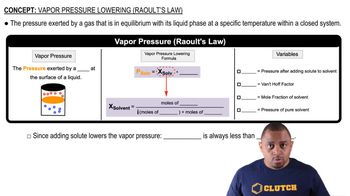
Vapor pressure is the pressure exerted by a vapor in equilibrium with its liquid or solid phase at a given temperature. It reflects the tendency of molecules to escape from the liquid phase into the gas phase. Compounds with weaker intermolecular forces generally exhibit higher vapor pressures because their molecules can more easily enter the vapor phase.
추천 영상:
가이드 코스
Raoult's Law and Vapor Pressure
Intermolecular Forces
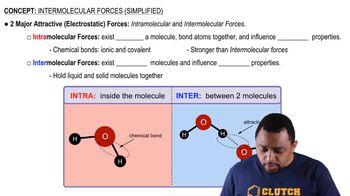
Intermolecular forces are the forces of attraction or repulsion between neighboring particles (atoms, molecules, or ions). These forces include hydrogen bonding, dipole-dipole interactions, and London dispersion forces. Stronger intermolecular forces result in lower vapor pressures, as more energy is required for molecules to escape into the vapor phase.
추천 영상:
가이드 코스
Intermolecular vs Intramolecular Forces
Hydrogen Bonding
Hydrogen bonding is a specific type of strong dipole-dipole interaction that occurs when hydrogen is bonded to highly electronegative atoms like oxygen, nitrogen, or fluorine. In the context of alcohols, such as CH3CH2CH2OH and CH3OH, hydrogen bonding significantly influences their physical properties, including vapor pressure. The presence of more hydrogen bonds typically leads to lower vapor pressure due to the increased energy required to break these interactions.
추천 영상:
가이드 코스
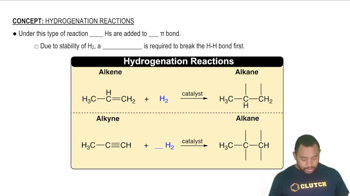
Hydrogenation Reactions
관련 실천
교과서 질문
1630
views
1
rank
교과서 질문
In each pair of compounds, pick the one with the higher boiling point. Explain your reasoning. b. CS2 or CO2
630
views
교과서 질문
Determine whether each pair of compounds forms a homogeneous solution when combined. For those that form homogeneous solutions, indicate the type of forces that are involved. d. CH3CH2OH and H2O
1909
views
교과서 질문
Determine whether each pair of compounds forms a homogeneous solution when combined. For those that form homogeneous solutions, indicate the type of forces that are involved. a. CH3CH2CH2CH2CH3 and CH3CH2CH2CH2CH2CH3 b. CBr4 and H2O c. LiNO3 and H2O d. CH3OH and CH3CH2CH2CH2CH3
교과서 질문
In each pair of compounds, pick the one with the higher vapor pressure at a given temperature. Explain your reasoning. a. CH4 or CH3Cl c. CH3OH or H2CO
1380
views