Ch.11 - Liquids, Solids & Intermolecular Forces
Tro - Chemistry: A Molecular Approach 4th Edition
Tro4th EditionChemistry: A Molecular ApproachISBN: 9780134112831당신이 사용하는 게 아니라요?교과서 변경
11장, 문제 51

Why does water in a glass tube with grease or oil residue display a flat meniscus, whereas water in a clean glass tube displays a concave meniscus?

검증된 단계별 안내
1
Understand the concept of meniscus: A meniscus is the curve seen at the top of a liquid in response to its container. It can be concave or convex depending on the liquid and the container material.
Identify the forces involved: The shape of the meniscus is determined by the balance between cohesive forces (attraction between like molecules) and adhesive forces (attraction between unlike molecules).
Consider water in a clean glass tube: Water has strong adhesive forces with glass, which are greater than its cohesive forces. This causes the water to climb up the sides of the glass, creating a concave meniscus.
Consider the effect of grease or oil: Grease or oil residue on the glass reduces the adhesive forces between the water and the glass. This diminishes the water's ability to climb the sides of the tube.
Explain the flat meniscus: With reduced adhesive forces due to the grease or oil, the cohesive forces within the water become more dominant, leading to a flatter meniscus compared to a clean glass tube.

주요 개념

질문에 올바르게 답하기 위해 반드시 이해해야 하는 핵심 개념들은 다음과 같습니다.

Meniscus Formation

A meniscus is the curve in the surface of a liquid in response to its container. It forms due to the balance between cohesive forces (attraction between liquid molecules) and adhesive forces (attraction between liquid molecules and the container). The shape of the meniscus can be concave or convex, depending on the relative strength of these forces.
추천 영상:
가이드 코스
02:34
Enthalpy of Formation

Cohesion and Adhesion

Cohesion refers to the intermolecular forces that hold similar molecules together, while adhesion describes the attraction between different substances. In the case of water, strong adhesive forces with clean glass lead to a concave meniscus, as water molecules are drawn up the sides of the tube. Conversely, grease or oil reduces adhesion, resulting in a flat meniscus due to the dominance of cohesive forces.
추천 영상:
가이드 코스
03:13
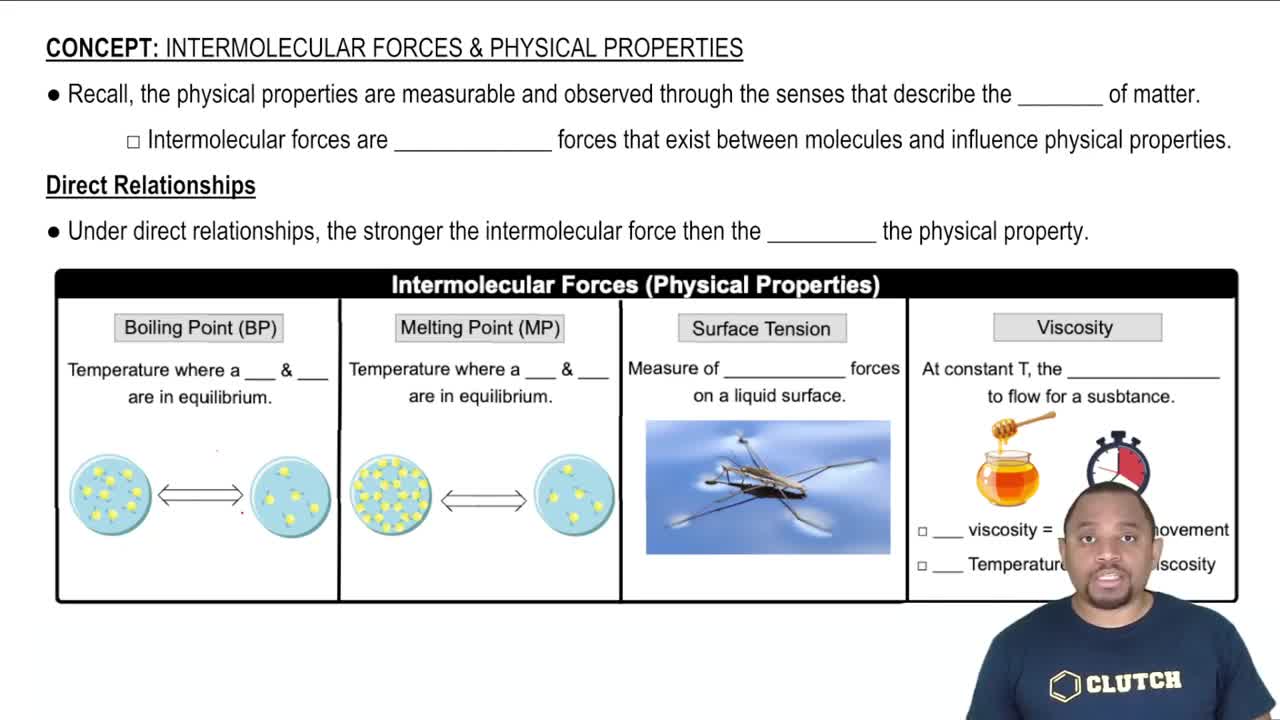
Intermolecular Forces and Properties

Surface Tension

Surface tension is the elastic tendency of a fluid surface that makes it acquire the least surface area possible. It arises from cohesive forces between liquid molecules at the surface. In a clean glass tube, water's high surface tension contributes to the formation of a concave meniscus, while the presence of grease or oil disrupts these cohesive interactions, leading to a flat meniscus.
추천 영상:
가이드 코스
03:13
Intermolecular Forces and Properties