
Ch.14 - Chemical Kinetics
Tro - Chemistry: A Molecular Approach 4th Edition
Tro4th EditionChemistry: A Molecular ApproachISBN: 9780134112831당신이 사용하는 게 아니라요?교과서 변경
14장, 문제 108

What rate law corresponds to the proposed mechanism for the formation of hydrogen iodide, which can be written in simplified form as: I2 Δk1k-1 2I (Fast), I + H2 Δk2k-2 H2I (Fast), H2I + I ¡k3 2HI (Slow)?

검증된 단계별 안내
1
Identify the slow step in the mechanism, as it determines the rate law. In this case, the slow step is: \( \text{H}_2\text{I} + \text{I} \xrightarrow{k_3} 2\text{HI} \).
Write the rate law based on the slow step. The rate of the reaction is determined by the concentration of the reactants in the slow step: \( \text{Rate} = k_3 [\text{H}_2\text{I}][\text{I}] \).
Express the intermediate \( \text{H}_2\text{I} \) in terms of the initial reactants using the fast equilibrium steps. From the second fast step: \( \text{I} + \text{H}_2 \rightleftharpoons \text{H}_2\text{I} \), we have \( K_2 = \frac{[\text{H}_2\text{I}]}{[\text{I}][\text{H}_2]} \).
Solve for \( [\text{H}_2\text{I}] \) in terms of \( [\text{I}] \) and \( [\text{H}_2] \) using the equilibrium constant \( K_2 \): \( [\text{H}_2\text{I}] = K_2 [\text{I}][\text{H}_2] \).
Substitute \( [\text{H}_2\text{I}] \) from the previous step into the rate law: \( \text{Rate} = k_3 K_2 [\text{I}]^2 [\text{H}_2] \). This is the rate law for the overall reaction.

주요 개념

질문에 올바르게 답하기 위해 반드시 이해해야 하는 핵심 개념들은 다음과 같습니다.

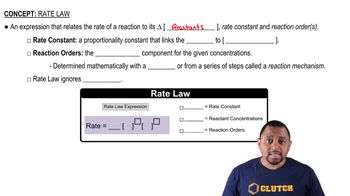
Rate Law

A rate law expresses the relationship between the rate of a chemical reaction and the concentration of its reactants. It is typically formulated as rate = k[A]^m[B]^n, where k is the rate constant, and m and n are the orders of the reaction with respect to reactants A and B. Understanding how to derive the rate law from a proposed reaction mechanism is crucial for predicting how changes in concentration affect the reaction rate.
추천 영상:
가이드 코스
01:52
Rate Law Fundamentals

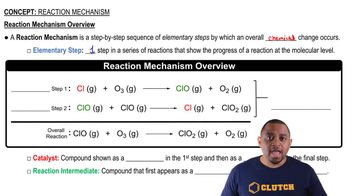
Reaction Mechanism

A reaction mechanism is a step-by-step description of the pathway taken during a chemical reaction, detailing each elementary step involved. Each step can have different rates, and the slowest step, known as the rate-determining step, dictates the overall reaction rate. Analyzing the proposed mechanism helps in identifying which steps contribute to the rate law and how intermediates are involved.
추천 영상:
가이드 코스
03:06
Reaction Mechanism Overview

Elementary Steps and Rate-Determining Step

Elementary steps are individual reactions that occur in a mechanism, each with its own rate constant. The rate-determining step is the slowest step in the mechanism, which limits the overall rate of the reaction. In the given mechanism, identifying the slow step allows us to derive the rate law by focusing on the concentrations of the reactants involved in that step, while considering the fast steps as equilibria.
추천 영상:
가이드 코스
01:15
Rate Law Determination