Ch.14 - Chemical Kinetics
Tro - Chemistry: A Molecular Approach 4th Edition
Tro4th EditionChemistry: A Molecular ApproachISBN: 9780134112831당신이 사용하는 게 아니라요?교과서 변경
14장, 문제 39a

A reaction in which A, B, and C react to form products is first order in A, second order in B, and zero order in C.
a. Write a rate law for the reaction.

검증된 단계별 안내
1
Identify the order of reaction with respect to each reactant: first order in A, second order in B, and zero order in C.
Recall that the rate law for a reaction is expressed as: \( \text{Rate} = k[A]^m[B]^n[C]^p \), where \( k \) is the rate constant, and \( m, n, \) and \( p \) are the orders of the reaction with respect to A, B, and C, respectively.
Substitute the given orders into the rate law expression: \( m = 1 \), \( n = 2 \), and \( p = 0 \).
Write the rate law using the substituted values: \( \text{Rate} = k[A]^1[B]^2[C]^0 \).
Simplify the rate law expression, noting that any term raised to the power of zero is equal to one: \( \text{Rate} = k[A][B]^2 \).

비슷한 문제에 대한 검증된 영상 답변:

이 영상 해법은 위 문제에 도움이 된다고 튜터들이 추천한 것입니다.
영상 길이:
4m
도움이 되었나요?

주요 개념

질문에 올바르게 답하기 위해 반드시 이해해야 하는 핵심 개념들은 다음과 같습니다.

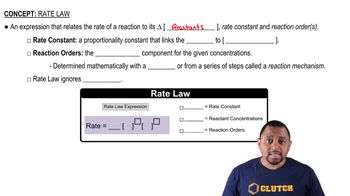
Rate Law

The rate law of a chemical reaction expresses the relationship between the rate of the reaction and the concentration of its reactants. It is typically formulated as rate = k[A]^m[B]^n[C]^p, where k is the rate constant, and m, n, and p are the orders of the reaction with respect to each reactant. The orders indicate how the rate is affected by changes in concentration.
추천 영상:
가이드 코스
01:52
Rate Law Fundamentals

Order of Reaction

The order of a reaction refers to the power to which the concentration of a reactant is raised in the rate law. It can be determined experimentally and indicates how the rate of reaction changes with varying concentrations. For example, a first-order reaction in A means that doubling the concentration of A will double the reaction rate, while a second-order reaction in B means that doubling B will quadruple the rate.
추천 영상:
가이드 코스
00:36
Average Bond Order

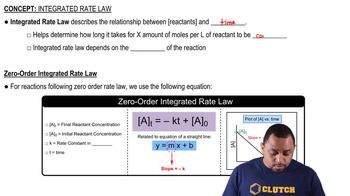
Zero-Order Reactions

In a zero-order reaction, the rate of reaction is constant and does not depend on the concentration of the reactant. This means that changes in the concentration of the zero-order reactant (in this case, C) have no effect on the reaction rate. Zero-order behavior often occurs when a reactant is saturated or when the reaction is limited by a factor other than concentration.
추천 영상:
가이드 코스
02:44
Zero-Order Reactions
관련 실천
교과서 질문

What are the units of k for each type of reaction?

a. first-order reaction

b. second-order reaction

c. zero-order reaction

1049
views

교과서 질문

A reaction in which A, B, and C react to form products is first order in A, second order in B, and zero order in C c. By what factor does the reaction rate change if [A] is doubled (and the other reactant concentrations are held constant)? d. By what factor does the reaction rate change if [B] is doubled (and the other reactant concentrations are held constant)? e. By what factor does the reaction rate change if [C] is doubled? f. By what factor does the reaction rate change if the concentrations of all three reactants are doubled?

858
views
교과서 질문

A reaction in which A, B, and C react to form products is zero order in A, one-half order in B, and second order in C. a. Write a rate law for the reaction.

833
views
교과서 질문

A reaction in which A, B, and C react to form products is first order in A, second order in B, and zero order in C. b. What is the overall order of the reaction?

422
views
교과서 질문

This reaction is first order in N2O5: N2O5(g) → NO3(g) + NO2(g) The rate constant for the reaction at a certain temperature is 0.053/s. a. Calculate the rate of the reaction when [N2O5] = 0.055 M

531
views
교과서 질문

This reaction is first order in N2O5: N2O5(g) → NO3(g) + NO2(g) The rate constant for the reaction at a certain temperature is 0.053/s. b. What would the rate of the reaction be at the concentration indicated in part a if the reaction were second order? Zero order? (Assume the same numerical value for the rate constant with the appropriate units.)

2748
views
1
rank