
Ch.14 - Chemical Kinetics
Tro - Chemistry: A Molecular Approach 4th Edition
Tro4th EditionChemistry: A Molecular ApproachISBN: 9780134112831당신이 사용하는 게 아니라요?교과서 변경
14장, 문제 105a

Consider the gas-phase reaction: H2(g) + I2(g) → 2 HI(g) The reaction was experimentally determined to be first order in H2 and first order in I2. Consider the proposed mechanisms. Proposed mechanism I: H2(g) + I2(g) → 2 HI(g) Single step Proposed mechanism II: I2(g) Δk1k-12 I(g) Fast H2( g) + 2 I( g) → k22 HI( g) Slow a. Show that both of the proposed mechanisms are valid.

검증된 단계별 안내
1
insert step 1> Identify the overall reaction and the rate law from the experimental data. The overall reaction is H2(g) + I2(g) → 2 HI(g), and the rate law is rate = k[H2][I2], indicating first order in both H2 and I2.
insert step 2> Analyze Proposed Mechanism I: This is a single-step mechanism where the rate law can be directly written from the stoichiometry of the reaction. Since the reaction is elementary, the rate law is rate = k[H2][I2], which matches the experimental rate law.
insert step 3> Analyze Proposed Mechanism II: This involves two steps. The first step is the fast equilibrium I2(g) ⇌ 2 I(g), and the second step is the slow step H2(g) + 2 I(g) → 2 HI(g).
insert step 4> For Proposed Mechanism II, write the rate law for the slow step, which is the rate-determining step: rate = k2[H2][I]^2.
insert step 5> Use the equilibrium expression from the fast step to express [I] in terms of [I2]: K_eq = [I]^2/[I2], so [I]^2 = K_eq[I2]. Substitute this into the rate law for the slow step to show that rate = k'[H2][I2], where k' = k2K_eq, which matches the experimental rate law.

비슷한 문제에 대한 검증된 영상 답변:

이 영상 해법은 위 문제에 도움이 된다고 튜터들이 추천한 것입니다.
영상 길이:
3m

주요 개념

질문에 올바르게 답하기 위해 반드시 이해해야 하는 핵심 개념들은 다음과 같습니다.

Reaction Order

Reaction order refers to the power to which the concentration of a reactant is raised in the rate law of a chemical reaction. In this case, the reaction is first order in both H2 and I2, meaning that the rate of reaction is directly proportional to the concentration of each reactant. Understanding reaction order is crucial for analyzing how changes in concentration affect the reaction rate.
추천 영상:
가이드 코스
00:36
Average Bond Order

Mechanism of Reaction

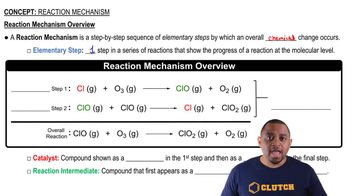
A reaction mechanism is a step-by-step description of the pathway taken by reactants to form products. It includes elementary steps that detail how bonds are broken and formed. Evaluating proposed mechanisms involves determining if they can account for the observed reaction order and rate, which is essential for validating their correctness.
추천 영상:
가이드 코스
03:06
Reaction Mechanism Overview

Rate Law and Rate Constants

The rate law expresses the relationship between the rate of a chemical reaction and the concentration of its reactants, often incorporating rate constants for each step in a mechanism. For the proposed mechanisms, the rate constants (k1, k-1, k2) play a critical role in determining the overall rate of the reaction and validating the mechanisms based on the experimental data provided.
추천 영상:
가이드 코스
00:45
Rate Constant Units
관련 실천
교과서 질문

Anthropologists can estimate the age of a bone or other sample of organic matter by its carbon-14 content. The carbon-14 in a living organism is constant until the organism dies, after which carbon- 14 decays with first-order kinetics and a half-life of 5730 years. Suppose a bone from an ancient human contains 19.5% of the C-14 found in living organisms. How old is the bone?

2725
views
교과서 질문

Consider the gas-phase reaction: H2(g) + I2(g) → 2 HI(g) The reaction was experimentally determined to be first order in H2 and first order in I2. Consider the proposed mechanisms. Proposed mechanism I: H2(g) + I2(g) → 2 HI(g) Single step Proposed mechanism II: I2(g) Δk1k-12 I(g) Fast H2( g) + 2 I( g) → k22 HI( g) Slow b. What kind of experimental evidence might lead you to favor mechanism II over mechanism I?

1632
views
교과서 질문

Consider the two reactions:

O + N2 → NO + N Ea = 315 kJ/mol

Cl + H2 → HCl + H Ea = 23 kJ/mol

b. The frequency factors for these two reactions are very close to each other in value. Assuming that they are the same, calculate the ratio of the reaction rate constants for these two reactions at 25 °C.

689
views
교과서 질문

Consider the reaction: 2 NH3(aq) + OCl-(aq) → N2H4(aq) + H2O(l) + Cl- (aq) This three-step mechanism is proposed: NH3(aq) + OCl- (aq) Δk1k2 NH2Cl(aq) + OH- (aq) Fast NH2Cl(aq) + NH3(aq) →k3 N2H5+ (aq) + Cl- (aq) Slow N2H5+ (aq) + OH-(aq) →k4 N2H4(aq) + H2O(l) Fast a. Show that the mechanism sums to the overall reaction.

878
views