Ch.14 - Chemical Kinetics
Tro - Chemistry: A Molecular Approach 4th Edition
Tro4th EditionChemistry: A Molecular ApproachISBN: 9780134112831당신이 사용하는 게 아니라요?교과서 변경
14장, 문제 30

Consider the reaction: 8 H2S(g) + 4 O2(g) → 8 H2O(g) + S8(g) Complete the table.

검증된 단계별 안내
1
Step 1: Identify the balanced chemical equation. In this case, it is 8 H2S(g) + 4 O2(g) → 8 H2O(g) + S8(g). This equation tells us that 8 moles of hydrogen sulfide react with 4 moles of oxygen to produce 8 moles of water and 1 mole of sulfur.
Step 2: Identify the given information in the problem. This could be the initial amounts of reactants, the amount of one of the products, or the final amounts of the reactants. This information will be used to fill in the table.
Step 3: Use the stoichiometric coefficients in the balanced chemical equation to determine the relationships between the amounts of reactants and products. For example, the equation tells us that for every 8 moles of H2S that react, 8 moles of H2O are produced and for every 4 moles of O2 that react, 1 mole of S8 is produced.
Step 4: Use the relationships determined in step 3 to fill in the missing values in the table. If you know the amount of one substance, you can use the stoichiometric coefficients to find the amounts of the other substances.
Step 5: Check your work. Make sure that the amounts of reactants and products in the table are consistent with the balanced chemical equation and with each other. If they are not, go back and check your calculations.

비슷한 문제에 대한 검증된 영상 답변:

이 영상 해법은 위 문제에 도움이 된다고 튜터들이 추천한 것입니다.
영상 길이:
8m
도움이 되었나요?

주요 개념

질문에 올바르게 답하기 위해 반드시 이해해야 하는 핵심 개념들은 다음과 같습니다.

Stoichiometry

Stoichiometry is the branch of chemistry that deals with the quantitative relationships between the reactants and products in a chemical reaction. It allows chemists to predict the amounts of substances consumed and produced in a reaction based on balanced chemical equations. Understanding stoichiometry is essential for completing tables that require calculations of moles, mass, or volume of reactants and products.
추천 영상:
가이드 코스
01:16
Stoichiometry Concept

Balancing Chemical Equations

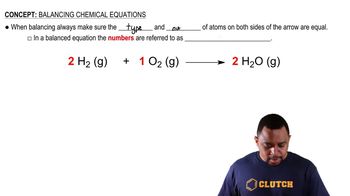
Balancing chemical equations is the process of ensuring that the number of atoms for each element is the same on both sides of the equation. This is crucial because it reflects the law of conservation of mass, which states that matter cannot be created or destroyed in a chemical reaction. A balanced equation provides the correct stoichiometric ratios needed for calculations in stoichiometry.
추천 영상:
가이드 코스
01:32
Balancing Chemical Equations

Gas Laws

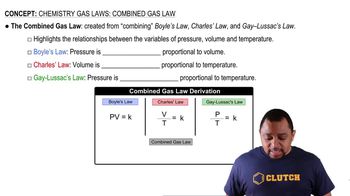
Gas laws describe the behavior of gases in relation to pressure, volume, temperature, and the number of moles. Understanding these laws, such as the ideal gas law (PV=nRT), is important when dealing with gaseous reactants and products in a reaction. In the context of the given reaction, gas laws can help in calculating the volumes of gases involved under specific conditions.
추천 영상:
가이드 코스
01:43
Combined Gas Law