Ch.14 - Chemical Kinetics
Tro - Chemistry: A Molecular Approach 4th Edition
Tro4th EditionChemistry: A Molecular ApproachISBN: 9780134112831당신이 사용하는 게 아니라요?교과서 변경
14장, 문제 32a

Consider the reaction: NO2(g) → NO(g) + 1/2 O2(g) The tabulated data were collected for the concentration of NO2 as a function of time: a. What is the average rate of the reaction between 10 and 20 s? Between 50 and 60 s?

검증된 단계별 안내
1
Identify the change in concentration of NO2 between the times 10 s and 20 s, and between 50 s and 60 s. This can be done by subtracting the concentration of NO2 at the start time from the concentration at the end time for each interval.
Calculate the time intervals for each period. For the first interval, subtract the start time (10 s) from the end time (20 s). Do the same for the second interval, subtracting 50 s from 60 s.
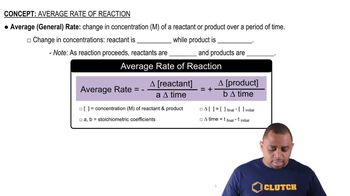
Use the formula for average rate of reaction, which is the change in concentration divided by the change in time. Apply this formula separately for each time interval.
For the reaction NO2(g) → NO(g) + 1/2 O2(g), note that the disappearance of NO2 indicates the progress of the reaction. Therefore, the average rate should be expressed as a negative value, indicating the consumption of NO2.
Compare the average rates calculated for the two intervals to observe how the rate changes over time. This can provide insights into the kinetics of the reaction.

비슷한 문제에 대한 검증된 영상 답변:

이 영상 해법은 위 문제에 도움이 된다고 튜터들이 추천한 것입니다.
영상 길이:
3m

주요 개념

질문에 올바르게 답하기 위해 반드시 이해해야 하는 핵심 개념들은 다음과 같습니다.

Reaction Rate

The reaction rate is a measure of how quickly reactants are converted into products in a chemical reaction. It is typically expressed as the change in concentration of a reactant or product per unit time. Understanding how to calculate the average rate involves determining the difference in concentration over a specified time interval.
추천 영상:
가이드 코스
02:03
Average Rate of Reaction

Concentration

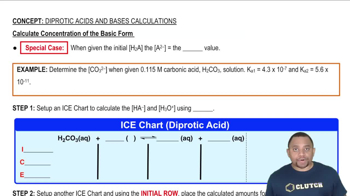
Concentration refers to the amount of a substance (solute) present in a given volume of solution or mixture. In the context of chemical reactions, it is crucial to know the concentrations of reactants and products at different times to calculate reaction rates. Concentration can be expressed in various units, such as molarity (moles per liter).
추천 영상:
가이드 코스
07:35
Calculate Concentration of the Basic Form

Time Intervals

Time intervals are specific periods during which measurements are taken to observe changes in a reaction. In this question, the average rate of reaction is calculated over two distinct time intervals (10-20 s and 50-60 s). Understanding how to analyze data over these intervals is essential for determining the average rate of the reaction accurately.
추천 영상:
가이드 코스
02:16
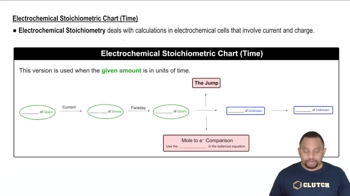
Electrochemical Stoichiometric Chart (Time)