Ch.14 - Chemical Kinetics
Tro - Chemistry: A Molecular Approach 4th Edition
Tro4th EditionChemistry: A Molecular ApproachISBN: 9780134112831당신이 사용하는 게 아니라요?교과서 변경
14장, 문제 28

For the reaction A(g) + 1/2 B(g) → 2 C(g): b. When C is increasing at a rate of 0.025 M/s, how fast is B decreasing? How fast is A decreasing? a. Determine the expression for the rate of the reaction in terms of the change in concentration of each of the reactants and products.

검증된 단계별 안내
1
insert step 1> Start by writing the general rate expression for the reaction: \( \text{Rate} = -\frac{1}{a} \frac{\Delta [A]}{\Delta t} = -\frac{1}{b} \frac{\Delta [B]}{\Delta t} = \frac{1}{c} \frac{\Delta [C]}{\Delta t} \), where \( a, b, \) and \( c \) are the stoichiometric coefficients of A, B, and C respectively.
insert step 2> For the given reaction \( A(g) + \frac{1}{2} B(g) \rightarrow 2 C(g) \), identify the stoichiometric coefficients: \( a = 1 \), \( b = \frac{1}{2} \), and \( c = 2 \).
insert step 3> Substitute the stoichiometric coefficients into the rate expression: \( \text{Rate} = -\frac{1}{1} \frac{\Delta [A]}{\Delta t} = -\frac{1}{\frac{1}{2}} \frac{\Delta [B]}{\Delta t} = \frac{1}{2} \frac{\Delta [C]}{\Delta t} \).
insert step 4> Given that \( \frac{\Delta [C]}{\Delta t} = 0.025 \text{ M/s} \), use the rate expression \( \frac{1}{2} \frac{\Delta [C]}{\Delta t} = -\frac{1}{\frac{1}{2}} \frac{\Delta [B]}{\Delta t} \) to find the rate at which B is decreasing.
insert step 5> Similarly, use the rate expression \( \frac{1}{2} \frac{\Delta [C]}{\Delta t} = -\frac{1}{1} \frac{\Delta [A]}{\Delta t} \) to find the rate at which A is decreasing.

주요 개념

질문에 올바르게 답하기 위해 반드시 이해해야 하는 핵심 개념들은 다음과 같습니다.

Stoichiometry

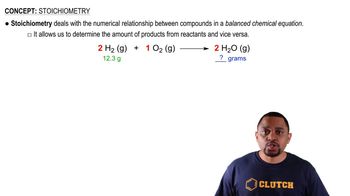
Stoichiometry is the quantitative relationship between reactants and products in a chemical reaction. It allows us to determine how the concentrations of substances change over time based on their coefficients in the balanced equation. In this case, the coefficients indicate that for every 1 mole of A and 0.5 moles of B consumed, 2 moles of C are produced.
추천 영상:
가이드 코스
01:16
Stoichiometry Concept

Rate of Reaction

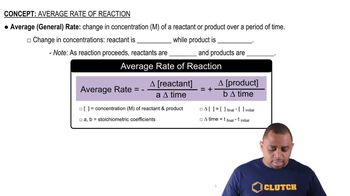
The rate of reaction refers to the speed at which reactants are converted into products. It can be expressed in terms of the change in concentration of reactants or products over time. For the given reaction, the rate can be defined using the changes in concentrations of A, B, and C, which are related through their stoichiometric coefficients.
추천 영상:
가이드 코스
02:03
Average Rate of Reaction

Differential Rate Law

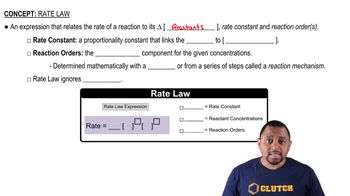
The differential rate law expresses the rate of a reaction as a function of the concentration of reactants. For the reaction A(g) + 1/2 B(g) → 2 C(g), the rate can be formulated as -1/1 * (d[A]/dt) = -2 * (d[B]/dt) = 1/2 * (d[C]/dt). This relationship allows us to calculate how the concentrations of A and B change in relation to the change in concentration of C.
추천 영상:
가이드 코스
01:52
Rate Law Fundamentals