
Ch.14 - Chemical Kinetics
Tro - Chemistry: A Molecular Approach 4th Edition
Tro4th EditionChemistry: A Molecular ApproachISBN: 9780134112831당신이 사용하는 게 아니라요?교과서 변경
14장, 문제 48c

Indicate the order of reaction consistent with each observation c. The half-life of the reaction gets longer as the initial concentration is increased.

검증된 단계별 안내
1
Understand that the half-life of a reaction is the time required for the concentration of a reactant to decrease to half of its initial concentration.
Recall that for a first-order reaction, the half-life is independent of the initial concentration, meaning it remains constant as the concentration changes.
For a zero-order reaction, the half-life decreases as the initial concentration increases, because the rate of reaction is constant and does not depend on concentration.
For a second-order reaction, the half-life increases as the initial concentration increases, because the rate of reaction is proportional to the square of the concentration.
Conclude that the observation that the half-life gets longer as the initial concentration is increased is consistent with a second-order reaction.

비슷한 문제에 대한 검증된 영상 답변:

이 영상 해법은 위 문제에 도움이 된다고 튜터들이 추천한 것입니다.
영상 길이:
1m
도움이 되었나요?

주요 개념

질문에 올바르게 답하기 위해 반드시 이해해야 하는 핵심 개념들은 다음과 같습니다.

Order of Reaction

The order of a reaction refers to the power to which the concentration of a reactant is raised in the rate law. It provides insight into how the rate of reaction depends on the concentration of reactants. Common orders include zero, first, and second, each indicating different relationships between concentration and reaction rate.
추천 영상:
가이드 코스
00:36
Average Bond Order

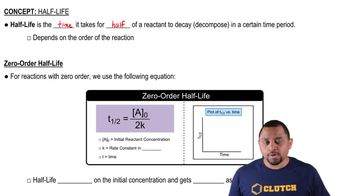
Half-Life

Half-life is the time required for the concentration of a reactant to decrease to half of its initial value. In chemical kinetics, the half-life can vary depending on the order of the reaction. For first-order reactions, the half-life is constant, while for second-order reactions, it increases with initial concentration.
추천 영상:
가이드 코스
02:17
Zero-Order Half-life

Kinetics and Concentration Relationship

In chemical kinetics, the relationship between reaction rate and concentration is crucial for determining the order of a reaction. If the half-life of a reaction increases with higher initial concentrations, it suggests a second-order reaction, where the rate depends on the square of the concentration. This contrasts with first-order reactions, where the half-life remains constant regardless of concentration.
추천 영상:
가이드 코스
03:06
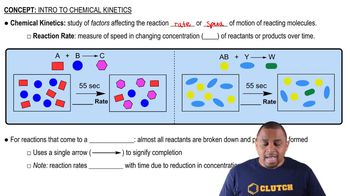
Chemical Kinetics
관련 실천
교과서 질문

The reaction A¡products was monitored as a function of time. The results are shown here. Time (s) [A] (M) 0 1.000 25 0.914 50 0.829 75 0.744 100 0.659 125 0.573 150 0.488 175 0.403 200 0.318 Determine the order of the reaction and the value of the rate constant. What is the rate of reaction when [A] = 0.10 M?

835
views
교과서 질문

The tabulated data show the concentration of AB versus time for this reaction: AB( g)¡A( g) + B( g) Time (s) [AB] (M) 0 0.950 50 0.459 100 0.302 150 0.225 200 0.180 250 0.149 300 0.128 350 0.112 400 0.0994 450 0.0894 500 0.0812 Determine the order of the reaction and the value of the rate constant. Predict the concentration of AB at 25 s.

3257
views
4
comments
교과서 질문

Indicate the order of reaction consistent with each observation.

a. The half-life of the reaction gets shorter as the initial concentration is increased.

b. A plot of the natural log of the concentration of the reactant versus time yields a straight line.

970
views
교과서 질문

The tabulated data were collected for this reaction: CH3Cl(g) + 3 Cl2(g) → CCl4( g) + 3 HCl(g)

Write an expression for the reaction rate law and calculate the value of the rate constant, k. What is the overall order of the reaction?

923
views
1
rank
교과서 질문

Indicate the order of reaction consistent with each observation. a. A plot of the concentration of the reactant versus time yields a straight line. Indicate the order of reaction consistent with each observation b. The reaction has a half-life that is independent of initial concentration. c. A plot of the inverse of the concentration versus time yields a straight line.