
Ch.14 - Chemical Kinetics
Tro - Chemistry: A Molecular Approach 4th Edition
Tro4th EditionChemistry: A Molecular ApproachISBN: 9780134112831당신이 사용하는 게 아니라요?교과서 변경
14장, 문제 46

The tabulated data were collected for this reaction: CH3Cl(g) + 3 Cl2(g) → CCl4( g) + 3 HCl(g)
Table showing concentrations of reactants and initial reaction rates for chemical kinetics.
Write an expression for the reaction rate law and calculate the value of the rate constant, k. What is the overall order of the reaction?

검증된 단계별 안내
1
Identify the general form of the rate law for the reaction: rate = k[A]^m[B]^n.
Use the data from the table to set up ratios of the rates and concentrations to determine the reaction orders m and n.
Compare experiments 1 and 2 where [B] is constant to find the order with respect to [A].
Compare experiments 1 and 3 where [A] is constant to find the order with respect to [B].
Once the orders m and n are determined, use any set of data from the table to solve for the rate constant k.

비슷한 문제에 대한 검증된 영상 답변:

이 영상 해법은 위 문제에 도움이 된다고 튜터들이 추천한 것입니다.
영상 길이:
5m
도움이 되었나요?

주요 개념

질문에 올바르게 답하기 위해 반드시 이해해야 하는 핵심 개념들은 다음과 같습니다.

Rate Law

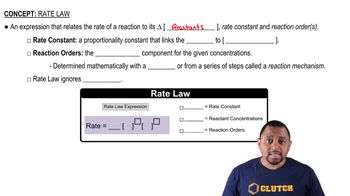
The rate law expresses the relationship between the rate of a chemical reaction and the concentration of its reactants. It is typically formulated as rate = k[A]^m[B]^n, where k is the rate constant, [A] and [B] are the concentrations of the reactants, and m and n are the reaction orders with respect to each reactant. Determining the rate law involves analyzing experimental data to find the values of m and n.
추천 영상:
가이드 코스
01:52
Rate Law Fundamentals

Order of Reaction

The order of a reaction is the sum of the exponents in the rate law expression. It indicates how the rate of reaction is affected by the concentration of the reactants. A reaction can be zero, first, second, or higher order, depending on the values of m and n. Understanding the order helps predict how changes in concentration will influence the reaction rate.
추천 영상:
가이드 코스
00:36
Average Bond Order

Rate Constant (k)

The rate constant, k, is a proportionality factor in the rate law that is specific to a particular reaction at a given temperature. It reflects the speed of the reaction and is influenced by factors such as temperature and the presence of catalysts. To calculate k, one can rearrange the rate law using known concentrations and initial rates from experimental data.
추천 영상:
가이드 코스
01:14
Equilibrium Constant K