Ch.14 - Chemical Kinetics
Tro - Chemistry: A Molecular Approach 4th Edition
Tro4th EditionChemistry: A Molecular ApproachISBN: 9780134112831당신이 사용하는 게 아니라요?교과서 변경
14장, 문제 80

Suppose that the reaction A¡products is exothermic and has an activation barrier of 75 kJ/mol. Sketch an energy diagram showing the energy of the reaction as a function of the progress of the reaction. Draw a second energy curve showing the effect of a catalyst.

검증된 단계별 안내
1
Start by drawing a graph with the y-axis labeled as 'Energy' and the x-axis labeled as 'Reaction Progress'.
Plot the energy of the reactants (A) at a certain level on the y-axis, indicating the starting point of the reaction.
Draw a curve that rises to a peak, representing the activation energy barrier of 75 kJ/mol, and then falls to a lower energy level than the reactants, indicating an exothermic reaction.
Label the peak of the curve as the 'Transition State', and the difference in energy between the reactants and the products as the 'Enthalpy Change (ΔH)', which is negative for an exothermic reaction.
Draw a second curve with a lower peak than the first, representing the effect of a catalyst, which lowers the activation energy but does not change the initial and final energy levels.

비슷한 문제에 대한 검증된 영상 답변:

이 영상 해법은 위 문제에 도움이 된다고 튜터들이 추천한 것입니다.
영상 길이:
2m

주요 개념

질문에 올바르게 답하기 위해 반드시 이해해야 하는 핵심 개념들은 다음과 같습니다.

Exothermic Reactions

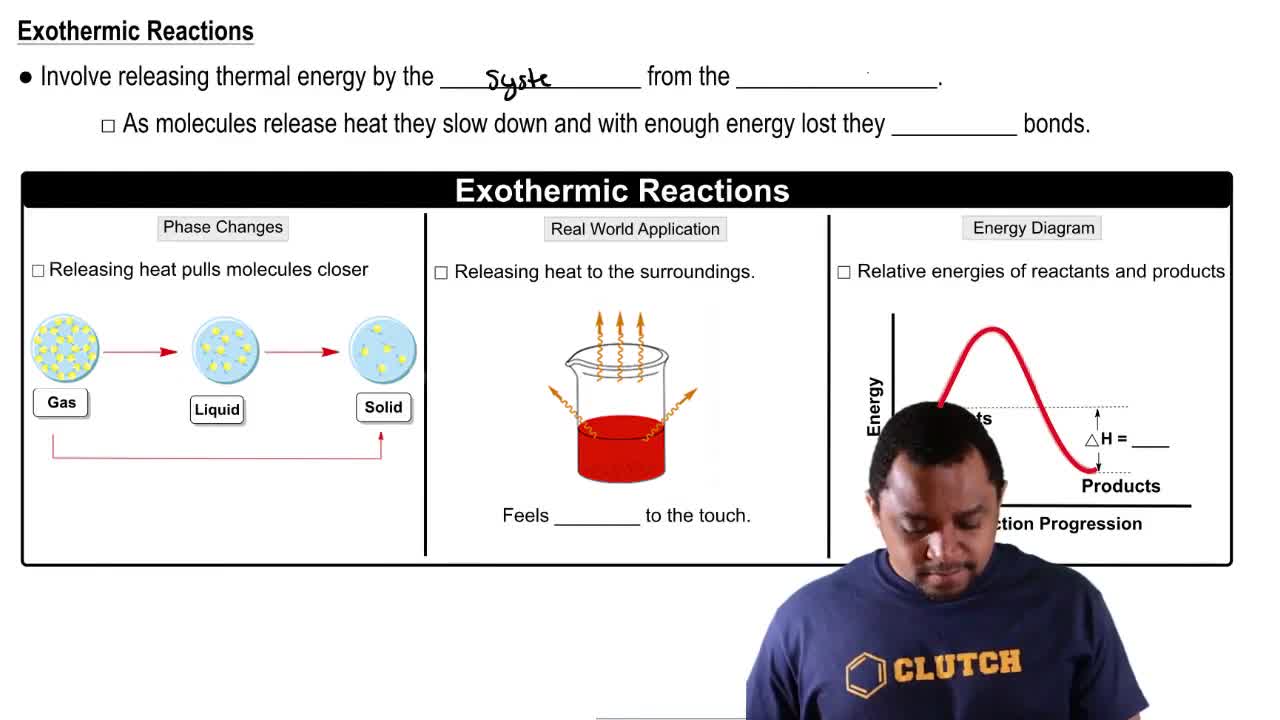
Exothermic reactions are chemical processes that release energy, usually in the form of heat, to the surroundings. This occurs when the total energy of the products is lower than that of the reactants, resulting in a negative change in enthalpy (ΔH). In the context of the given question, the reaction A → products releases energy, indicating that the products are more stable than the reactants.
추천 영상:
가이드 코스
02:38
Endothermic & Exothermic Reactions

Activation Energy

Activation energy is the minimum energy required for a chemical reaction to occur. It represents the energy barrier that reactants must overcome to transform into products. In the question, the activation barrier of 75 kJ/mol indicates the energy needed to initiate the exothermic reaction, which is depicted as a peak in the energy diagram.
추천 영상:
가이드 코스
02:02
Activity Series Chart

Catalysts

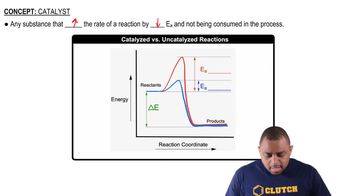
Catalysts are substances that increase the rate of a chemical reaction without being consumed in the process. They work by providing an alternative reaction pathway with a lower activation energy. In the energy diagram, the effect of a catalyst is shown as a second curve that has a lower peak than the uncatalyzed reaction, illustrating that the catalyst reduces the energy barrier for the reaction to proceed.
추천 영상:
가이드 코스
01:59
Catalyzed vs. Uncatalyzed Reactions