Ch.14 - Chemical Kinetics
Tro - Chemistry: A Molecular Approach 4th Edition
Tro4th EditionChemistry: A Molecular ApproachISBN: 9780134112831당신이 사용하는 게 아니라요?교과서 변경
14장, 문제 58b

The half-life for the radioactive decay of C-14 is 5730 years and is independent of the initial concentration. If a sample of C-14 initially contains 1.5 mmol of C-14, how many millimoles are left after 2255 years?

검증된 단계별 안내
1
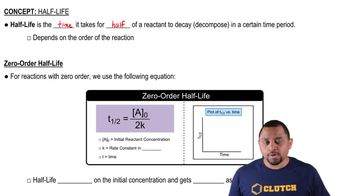
Step 1: Understand the concept of half-life. The half-life of a radioactive substance is the time it takes for half of the substance to decay. In this case, the half-life of C-14 is 5730 years, which means that after 5730 years, half of the initial amount of C-14 will have decayed.
Step 2: Calculate the number of half-lives that have passed. This can be done by dividing the total time that has passed (2255 years) by the half-life of the substance (5730 years).
Step 3: Use the formula for exponential decay to calculate the remaining amount of C-14. The formula is N = N0 * (1/2)^(t/t_half), where N is the final amount, N0 is the initial amount, t is the time that has passed, and t_half is the half-life.
Step 4: Substitute the given values into the formula. N0 is the initial amount of C-14, which is 1.5 mmol. t is the time that has passed, which is 2255 years. t_half is the half-life of C-14, which is 5730 years.
Step 5: Solve the equation to find the remaining amount of C-14. This will give you the amount of C-14 that is left after 2255 years.

비슷한 문제에 대한 검증된 영상 답변:

이 영상 해법은 위 문제에 도움이 된다고 튜터들이 추천한 것입니다.
영상 길이:
4m

주요 개념

질문에 올바르게 답하기 위해 반드시 이해해야 하는 핵심 개념들은 다음과 같습니다.

Half-life

Half-life is the time required for half of the radioactive nuclei in a sample to decay. For C-14, this period is 5730 years, meaning that after this time, only half of the original amount remains. Understanding half-life is crucial for calculating the remaining quantity of a radioactive substance after a specific time has elapsed.
추천 영상:
가이드 코스
02:17
Zero-Order Half-life

Exponential decay

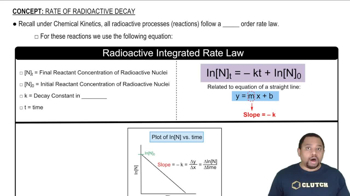
Exponential decay describes the process by which a quantity decreases at a rate proportional to its current value. In the context of radioactive decay, the amount of C-14 decreases exponentially over time, which can be mathematically represented by the equation N(t) = N0 * (1/2)^(t/T), where N0 is the initial amount, t is the elapsed time, and T is the half-life.
추천 영상:

Radioactive decay formula

The radioactive decay formula allows us to calculate the remaining quantity of a radioactive isotope after a certain period. For C-14, the formula can be applied to determine how much remains after 2255 years by substituting the values into the exponential decay equation, taking into account the half-life of 5730 years to find the remaining millimoles.
추천 영상:
가이드 코스
03:00
Rate of Radioactive Decay