Ch.15 - Chemical Equilibrium
Tro - Chemistry: A Molecular Approach 4th Edition
Tro4th EditionChemistry: A Molecular ApproachISBN: 9780134112831당신이 사용하는 게 아니라요?교과서 변경
15장, 문제 22b

Find and fix each mistake in the equilibrium constant expressions. b. CO(g) + Cl2(g) ⇌ COCl2(g) K = [CO][Cl2]/[COCl2]

검증된 단계별 안내
1
Step 1: Understand the equilibrium constant expression. The equilibrium constant expression for a reaction is the product of the concentrations of the products raised to their stoichiometric coefficients, divided by the product of the concentrations of the reactants raised to their stoichiometric coefficients.
Step 2: Identify the mistake in the given equilibrium constant expression. For the reaction CO(g) + Cl2(g) ⇌ COCl2(g), the equilibrium constant expression given is K = [CO][Cl2]/[COCl2]. This is incorrect because the reactants and products are in the wrong places.
Step 3: Correct the equilibrium constant expression. The correct equilibrium constant expression for this reaction should be K = [COCl2]/([CO][Cl2]). This is because COCl2 is the product and CO and Cl2 are the reactants.
Step 4: Remember that the concentrations in the equilibrium constant expression are equilibrium concentrations. These are the concentrations of the reactants and products at the point when the reaction has reached equilibrium.
Step 5: Always double-check your equilibrium constant expressions to make sure that the products are in the numerator and the reactants are in the denominator, each raised to their respective stoichiometric coefficients.

비슷한 문제에 대한 검증된 영상 답변:

이 영상 해법은 위 문제에 도움이 된다고 튜터들이 추천한 것입니다.
영상 길이:
1m
도움이 되었나요?

주요 개념

질문에 올바르게 답하기 위해 반드시 이해해야 하는 핵심 개념들은 다음과 같습니다.

Equilibrium Constant Expression

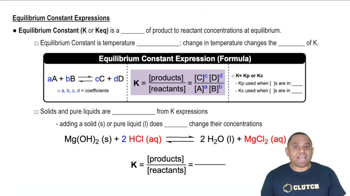
The equilibrium constant expression (K) quantifies the ratio of the concentrations of products to reactants at equilibrium for a reversible reaction. It is formulated based on the balanced chemical equation, where the concentrations of gaseous and aqueous species are included, while solids and liquids are omitted. The general form is K = [products]/[reactants], raised to the power of their stoichiometric coefficients.
추천 영상:
가이드 코스
03:20
Equilibrium Constant Expressions

Stoichiometry in Chemical Reactions

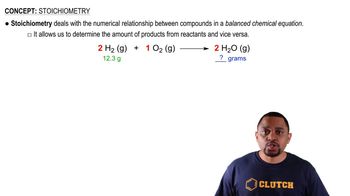
Stoichiometry involves the quantitative relationships between the reactants and products in a chemical reaction, derived from the balanced equation. Each substance's coefficient indicates the ratio in which they react or are produced. Understanding stoichiometry is essential for correctly formulating the equilibrium constant expression, as it dictates how concentrations are represented in the equation.
추천 영상:
가이드 코스
01:16
Stoichiometry Concept

Gaseous and Aqueous Species in K Expressions

In equilibrium constant expressions, only the concentrations of gaseous and aqueous species are included, while pure solids and liquids are excluded. This is because their activities are defined as 1, meaning they do not affect the equilibrium position. Recognizing which species to include is crucial for accurately calculating the equilibrium constant for a given reaction.
추천 영상:
가이드 코스
03:03
Amphoteric Species