Ch.15 - Chemical Equilibrium
Tro - Chemistry: A Molecular Approach 4th Edition
Tro4th EditionChemistry: A Molecular ApproachISBN: 9780134112831당신이 사용하는 게 아니라요?교과서 변경
15장, 문제 21

Write an expression for the equilibrium constant of each chemical equation.
a. SbCl5(g) ⇌ SbCl3(g) + Cl2(g)
b.2 BrNO(g) ⇌ 2 NO(g) + Br2(g)
c. CH4(g) + 2 H2S(g) ⇌ CS2(g) + 4 H2(g)
d. 2 CO(g) + O2(g) ⇌ 2 CO2(g)

검증된 단계별 안내
1
Step 1: Understand the concept of the equilibrium constant (K). The equilibrium constant is a measure of the ratio of the concentrations of products to reactants at equilibrium, with each concentration raised to the power of its stoichiometric coefficient in the balanced chemical equation.
Step 2: Identify the reactants and products in the given chemical equation. In the equation SbCl5(g) ⇌ SbCl3(g) + Cl2(g), SbCl5(g) is the reactant and SbCl3(g) and Cl2(g) are the products.
Step 3: Write the general form of the equilibrium constant expression. For a general reaction aA + bB ⇌ cC + dD, the equilibrium constant expression is K = ([C]^c [D]^d) / ([A]^a [B]^b), where [A], [B], [C], and [D] represent the molar concentrations of the species at equilibrium.
Step 4: Substitute the reactants and products into the equilibrium constant expression. For the given reaction, the equilibrium constant expression is K = ([SbCl3] [Cl2]) / [SbCl5].
Step 5: Note that the stoichiometric coefficients in the balanced chemical equation become the powers to which the concentrations are raised in the equilibrium constant expression. In this case, all coefficients are 1, so the concentrations are raised to the power of 1.

비슷한 문제에 대한 검증된 영상 답변:

이 영상 해법은 위 문제에 도움이 된다고 튜터들이 추천한 것입니다.
영상 길이:
1m
도움이 되었나요?

주요 개념

질문에 올바르게 답하기 위해 반드시 이해해야 하는 핵심 개념들은 다음과 같습니다.

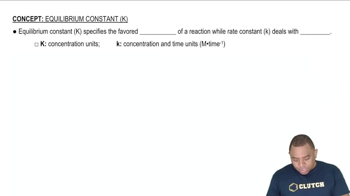
Equilibrium Constant (K)

The equilibrium constant (K) is a numerical value that expresses the ratio of the concentrations of products to reactants at equilibrium for a given chemical reaction. It is specific to a particular reaction at a certain temperature and provides insight into the extent to which a reaction proceeds. A larger K value indicates a greater concentration of products at equilibrium, while a smaller K suggests that reactants are favored.
추천 영상:
가이드 코스
01:14
Equilibrium Constant K

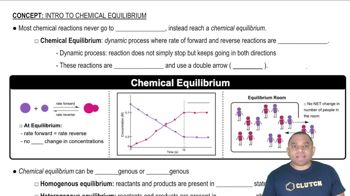
Chemical Equilibrium

Chemical equilibrium occurs when the rates of the forward and reverse reactions are equal, resulting in constant concentrations of reactants and products over time. At this point, the system is in a state of balance, and no net change is observed. Understanding this concept is crucial for writing equilibrium expressions, as it highlights the dynamic nature of reactions.
추천 영상:
가이드 코스
04:21
Chemical Equilibrium Concepts

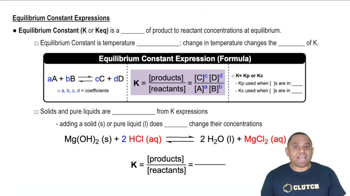
Writing Equilibrium Expressions

To write an equilibrium expression for a chemical reaction, the general form is K = [products]^coefficients / [reactants]^coefficients, where the brackets denote the molar concentrations of the species involved. For the reaction given, SbCl5(g) ∆ SbCl3(g) + Cl2(g), the equilibrium expression would be K = [SbCl3][Cl2] / [SbCl5]. This expression reflects the relationship between the concentrations of the reactants and products at equilibrium.
추천 영상:
가이드 코스
03:20
Equilibrium Constant Expressions