
Ch.15 - Chemical Equilibrium
Tro - Chemistry: A Molecular Approach 4th Edition
Tro4th EditionChemistry: A Molecular ApproachISBN: 9780134112831당신이 사용하는 게 아니라요?교과서 변경
15장, 문제 75

The reaction CO2(g) + C(s) ⇌ 2 CO(g) has Kp = 5.78 at 1200 K. a. Calculate the total pressure at equilibrium when 4.45 g of CO2 is introduced into a 10.0-L container and heated to 1200 K in the presence of 2.00 g of graphite. b. Repeat the calculation of part a in the presence of 0.50 g of graphite.

검증된 단계별 안내
1
Convert the mass of CO2 to moles using its molar mass: \( \text{moles of CO}_2 = \frac{4.45 \text{ g}}{44.01 \text{ g/mol}} \).
Set up an ICE (Initial, Change, Equilibrium) table to determine the changes in moles of each species at equilibrium. Initially, you have the moles of CO2 calculated and 0 moles of CO. Assume x moles of CO2 react to form 2x moles of CO.
Express the equilibrium partial pressures in terms of x and the initial moles. Use the ideal gas law \( P = \frac{nRT}{V} \) to find the partial pressures of CO2 and CO at equilibrium.
Write the expression for the equilibrium constant \( K_p = \frac{(P_{CO})^2}{P_{CO_2}} \) and substitute the expressions for the partial pressures in terms of x.
Solve the equation for x to find the equilibrium moles of each gas, then calculate the total pressure by summing the partial pressures of CO2 and CO.

주요 개념

질문에 올바르게 답하기 위해 반드시 이해해야 하는 핵심 개념들은 다음과 같습니다.

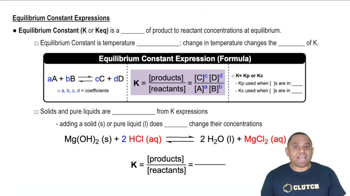
Equilibrium Constant (Kp)

The equilibrium constant (Kp) is a numerical value that expresses the ratio of the partial pressures of the products to the reactants at equilibrium for a given reaction at a specific temperature. For the reaction CO2(g) + C(s) ⇌ 2 CO(g), Kp = 5.78 indicates that at equilibrium, the pressure of CO is favored over CO2. Understanding Kp is essential for calculating the equilibrium state of the system.
추천 영상:
가이드 코스
03:20
Equilibrium Constant Expressions

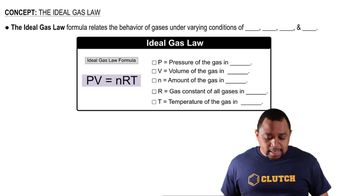
Ideal Gas Law

The Ideal Gas Law, represented as PV = nRT, relates the pressure (P), volume (V), number of moles (n), the ideal gas constant (R), and temperature (T) of a gas. This law is crucial for determining the total pressure in the container after introducing CO2 and graphite, as it allows for the calculation of the number of moles of gas present and how they contribute to the overall pressure at equilibrium.
추천 영상:
가이드 코스
01:15
Ideal Gas Law Formula

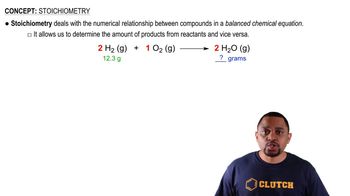
Stoichiometry of the Reaction

Stoichiometry involves the quantitative relationships between reactants and products in a chemical reaction. In this case, understanding the stoichiometry of the reaction CO2(g) + C(s) ⇌ 2 CO(g) is vital for determining how the introduction of CO2 and graphite affects the equilibrium concentrations of CO and CO2, which in turn influences the total pressure in the system.
추천 영상:
가이드 코스
01:16
Stoichiometry Concept
관련 실천
교과서 질문

Carbon monoxide replaces oxygen in oxygenated hemoglobin according to the reaction: HbO2(aq) + CO(aq) ⇌ HbCO(aq) + O2(aq) a. Use the reactions and associated equilibrium constants at body temperature given here to find the equilibrium constant for the reaction just shown. Hb(aq) + O2(aq) ⇌ HbO2(aq) Kc = 1.8 Hb(aq) + CO(aq) ⇌ HbCO(aq) Kc = 306

2555
views
교과서 질문

At 650 K, the reaction MgCO3(s) ⇌ MgO(s) + CO2(g) has Kp = 0.026. A 10.0-L container at 650 K has 1.0 g of MgO(s) and CO2 at P = 0.0260 atm. The container is then compressed to a volume of 0.100 L. Find the mass of MgCO3 that is formed.

2253
views
교과서 질문

Consider the exothermic reaction: C2H4(g) + Cl2(g) ⇌ C2H4Cl2(g) If you were trying to maximize the amount of C2H4Cl2 produced, which tactic might you try? Assume that the reaction mixture reaches equilibrium. a. increasing the reaction volume b. removing C2H4Cl2 from the reaction mixture as it forms c. lowering the reaction temperature d. adding Cl2

2119
views
교과서 질문

Coal can be used to generate hydrogen gas (a potential fuel) by the endothermic reaction: C(s) + H2O(g) ⇌ CO(g) + H2(g) If this reaction mixture is at equilibrium, predict whether each disturbance will result in the formation of additional hydrogen gas, the formation of less hydrogen gas, or have no effect on the quantity of hydrogen gas. e. adding a catalyst to the reaction mixture

1292
views
1
rank
교과서 질문

Coal, which is primarily carbon, can be converted to natural gas, primarily CH4, by the exothermic reaction: C(s) + 2 H2(g) ⇌ CH4(g) Which disturbance will favor CH4 at equilibrium? e. adding a catalyst to the reaction mixture

450
views