

Ch.16 - Acids and Bases
Tro - Chemistry: A Molecular Approach 4th Edition
Tro4th EditionChemistry: A Molecular ApproachISBN: 9780134112831당신이 사용하는 게 아니라요?교과서 변경
16장, 문제 128

Based on these molecular views, determine whether each pictured acid is weak or strong.

검증된 단계별 안내
1
Identify the molecular view of the acid in question. Look for the presence of ions and molecules in the solution.
Understand that a strong acid completely dissociates into its ions in solution, meaning you should see only ions and no intact acid molecules.
Recognize that a weak acid only partially dissociates, so you will see both ions and intact acid molecules in the solution.
Compare the molecular views: if the solution contains mostly ions, the acid is strong; if it contains a significant number of intact molecules, the acid is weak.
Use this analysis to determine whether each pictured acid is weak or strong based on the presence of ions and molecules in the molecular view.

비슷한 문제에 대한 검증된 영상 답변:

이 영상 해법은 위 문제에 도움이 된다고 튜터들이 추천한 것입니다.
영상 길이:
1m
도움이 되었나요?

주요 개념

질문에 올바르게 답하기 위해 반드시 이해해야 하는 핵심 개념들은 다음과 같습니다.

Strong vs. Weak Acids

Strong acids completely dissociate in water, releasing all their hydrogen ions (H+) and resulting in a high concentration of H+ ions in solution. In contrast, weak acids only partially dissociate, leading to a lower concentration of H+ ions. This distinction is crucial for predicting the behavior of acids in chemical reactions and their pH levels.
추천 영상:
가이드 코스
02:19
Weak Acid-Strong Base Titration Curve

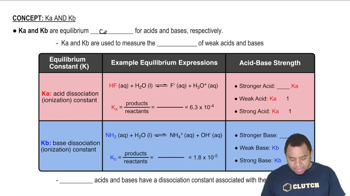
Dissociation Constant (Ka)

The acid dissociation constant (Ka) quantifies the strength of an acid in solution. A larger Ka value indicates a stronger acid, as it signifies a greater tendency to donate protons. Understanding Ka helps in comparing the strengths of different acids and predicting their behavior in various chemical environments.
추천 영상:
가이드 코스
03:50
Characteristics of Ka and Kb

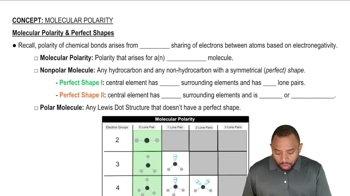
Molecular Structure and Polarity

The molecular structure and polarity of an acid influence its strength. Factors such as electronegativity, bond strength, and molecular size affect how easily an acid can donate a proton. For example, acids with highly electronegative atoms bonded to hydrogen tend to be stronger due to the increased polarity of the H-X bond, facilitating proton release.
추천 영상:
가이드 코스
02:38
Molecular Polarity
관련 실천
교과서 질문

The binding of oxygen by hemoglobin in the blood involves the equilibrium reaction: HbH+(aq) + O2(aq) ⇌ HbO2(aq) + H+(aq) In this equation, Hb is hemoglobin. The pH of normal human blood is highly controlled within a range of 7.35 to 7.45. Given the above equilibrium, why is this important? What would happen to the oxygen-carrying capacity of hemoglobin if blood became too acidic (a dangerous condition known as acidosis)?

10065
views
1
rank
교과서 질문

Based on these molecular views, determine whether each pictured acid is weak or strong.

705
views
교과서 질문

Identify the Lewis acid and Lewis base from among the reactants in each equation. b. AlBr3 + NH3 ⇌ H3NAlBr3 c. F(aq) + BF3(aq) ⇌ BF4(aq)

442
views
교과서 질문

Carbon dioxide dissolves in water according to the equations:

CO2(g) + H2O(l) ⇌ H2CO3(aq)

H2CO3(aq) + H2O(l) ⇌ HCO3(aq) + H3O+(aq)

Carbon dioxide levels in the atmosphere have increased about 20% over the last century. Given that Earth's oceans are exposed to atmospheric carbon dioxide, what effect might the increased CO2 be having on the pH of the world's oceans? What effect might this change be having on the limestone structures (primarily CaCO3) of coral reefs and marine shells?

8650
views
교과서 질문

Identify the Lewis acid and Lewis base from among the reactants in each equation. a. Ag+(aq) + 2 NH3(aq) ⇌ Ag(NH3)2+(aq)

1113
views
교과서 질문

People often take milk of magnesia to reduce the discomfort associated with acid stomach or heartburn. The recommended dose is 1 teaspoon, which contains 4.00×10² mg of Mg(OH)2. What volume of an HCl solution with a pH of 1.3 can be neutralized by one dose of milk of magnesia? If the stomach contains 2.00×10² mL of pH 1.3 solution, is all the acid neutralized? If not, what fraction is neutralized?

1198
views