Ch.16 - Acids and Bases
Tro - Chemistry: A Molecular Approach 4th Edition
Tro4th EditionChemistry: A Molecular ApproachISBN: 9780134112831당신이 사용하는 게 아니라요?교과서 변경
16장, 문제 101a,b,c,d

Determine if each salt will form a solution that is acidic, basic, or pH-neutral. a. FeCl3 b. NaF c. CaBr2 d. NH4Br

검증된 단계별 안내
1
Identify the cation and anion in each salt.
Determine if the cation is acidic, basic, or neutral.
Determine if the anion is acidic, basic, or neutral.
Combine the properties of the cation and anion to predict the pH of the solution.
Summarize the pH nature (acidic, basic, or neutral) for each salt based on the analysis of its ions.

비슷한 문제에 대한 검증된 영상 답변:

이 영상 해법은 위 문제에 도움이 된다고 튜터들이 추천한 것입니다.
영상 길이:
3m
도움이 되었나요?

주요 개념

질문에 올바르게 답하기 위해 반드시 이해해야 하는 핵심 개념들은 다음과 같습니다.

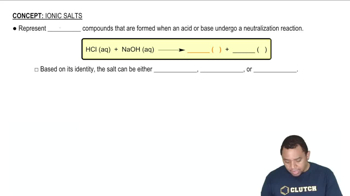
Salt Hydrolysis

Salt hydrolysis is the reaction of a salt with water to produce an acidic or basic solution. When a salt dissolves in water, its constituent ions can interact with water molecules, leading to the formation of hydronium ions (H3O+) or hydroxide ions (OH-), which determine the pH of the solution.
추천 영상:

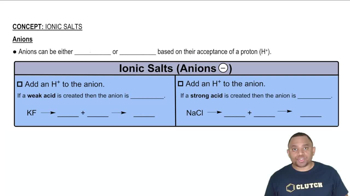
Acidic and Basic Ions

The nature of the ions derived from a salt influences whether the solution will be acidic, basic, or neutral. Cations from strong acids (like HCl) and anions from strong bases (like NaOH) typically yield neutral solutions, while cations from weak bases or anions from weak acids can lead to acidic or basic solutions, respectively.
추천 영상:
가이드 코스
01:53
Anion Acidity and Basicity

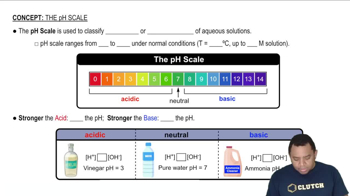
pH Scale

The pH scale measures the acidity or basicity of a solution, ranging from 0 to 14. A pH of 7 is considered neutral, below 7 is acidic, and above 7 is basic. Understanding the pH scale is essential for predicting the behavior of solutions formed from salts, as it helps classify the resulting solution based on the concentration of H3O+ and OH- ions.
추천 영상: