Ch.16 - Acids and Bases
Tro - Chemistry: A Molecular Approach 4th Edition
Tro4th EditionChemistry: A Molecular ApproachISBN: 9780134112831당신이 사용하는 게 아니라요?교과서 변경
16장, 문제 100d

Determine whether each cation is acidic or pH-neutral. For each cation that is acidic, write an equation that shows how the cation acts as an acid. d. Li+

검증된 단계별 안내
1
Identify the nature of the cation: Li^+ is a Group 1 metal cation.
Recall that cations from Group 1 metals, such as Li^+, are typically pH-neutral because they do not react with water to form H^+ ions.
Understand that acidic cations are usually those that can donate a proton (H^+) or increase the concentration of H^+ in solution.
Since Li^+ does not have the ability to donate a proton or increase H^+ concentration, it is considered pH-neutral.
Conclude that Li^+ is a pH-neutral cation and does not act as an acid in aqueous solution.

비슷한 문제에 대한 검증된 영상 답변:

이 영상 해법은 위 문제에 도움이 된다고 튜터들이 추천한 것입니다.
영상 길이:
1m
도움이 되었나요?

주요 개념

질문에 올바르게 답하기 위해 반드시 이해해야 하는 핵심 개념들은 다음과 같습니다.

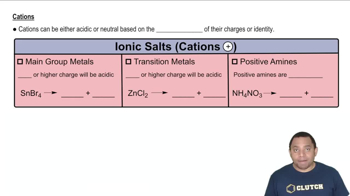
Acidic Cations

Acidic cations are positively charged ions that can donate protons (H+) in solution, thereby lowering the pH. These cations typically come from weak bases or are transition metals that can hydrolyze in water, forming acidic solutions. Understanding whether a cation is acidic involves analyzing its ability to interact with water and affect the concentration of hydrogen ions.
추천 영상:
가이드 코스
02:26
Cation Acidity in Salts

pH Neutral Cations

pH neutral cations do not significantly affect the pH of a solution. They are usually derived from strong bases and do not hydrolyze in water, meaning they do not release protons. An example of a pH-neutral cation is Li+, which does not react with water to produce H+ ions, thus maintaining a neutral pH.
추천 영상:

Hydrolysis Reactions

Hydrolysis reactions involve the reaction of a cation with water, leading to the formation of an acid or base. In the case of acidic cations, hydrolysis results in the release of H+ ions, which can be represented by an equation. For example, if a cation is acidic, the hydrolysis reaction can be written as: M^n+ + H2O ⇌ MH(n-1)+ + H+, where M^n+ is the cation.
추천 영상:
가이드 코스
01:30
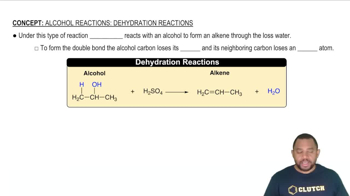
Alcohol Reactions: Dehydration Reactions