In each reaction, identify the Brønsted–Lowry acid, the Brønsted–Lowry base, the conjugate acid, and the conjugate base. c. CO32–(aq) + H2O(l) ⇌ HCO3–(aq) + OH–(aq)
Ch.16 - Acids and Bases
16장, 문제 35d
In each reaction, identify the Brønsted–Lowry acid, the Brønsted–Lowry base, the conjugate acid, and the conjugate base. d. C5H5N(aq) + H2O(l) ⇌ C5H5NH+(aq) + OH–(aq)
검증된 단계별 안내1
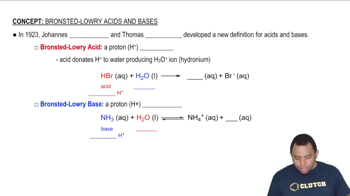
Identify the Brønsted–Lowry acid and base in the reactants: The Brønsted–Lowry acid is the species that donates a proton (H+), and the Brønsted–Lowry base is the species that accepts a proton.
In the given reaction, water (H2O) donates a proton to C5H5N, making H2O the Brønsted–Lowry acid.
C5H5N accepts a proton from H2O, making C5H5N the Brønsted–Lowry base.
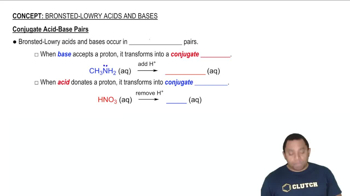
Identify the conjugate acid and conjugate base in the products: The conjugate acid is the species formed when the base gains a proton, and the conjugate base is the species formed when the acid loses a proton.
C5H5NH+ is the conjugate acid formed from C5H5N, and OH- is the conjugate base formed from H2O.

비슷한 문제에 대한 검증된 영상 답변:
이 영상 해법은 위 문제에 도움이 된다고 튜터들이 추천한 것입니다.
영상 길이:
2m도움이 되었나요?
주요 개념
질문에 올바르게 답하기 위해 반드시 이해해야 하는 핵심 개념들은 다음과 같습니다.
Brønsted–Lowry Acid-Base Theory
The Brønsted–Lowry theory defines acids as proton donors and bases as proton acceptors. In this framework, an acid-base reaction involves the transfer of protons (H+) from the acid to the base. This theory expands the understanding of acid-base reactions beyond just the presence of hydroxide ions, allowing for a broader range of reactions to be classified.
추천 영상:
가이드 코스
Bronsted-Lowry Acid-Base Theory
Conjugate Acid and Base
In the context of Brønsted–Lowry theory, a conjugate acid is formed when a base accepts a proton, while a conjugate base is what remains after an acid donates a proton. This relationship is crucial for understanding the equilibrium of acid-base reactions, as it illustrates how substances can act as both acids and bases depending on the reaction context.
추천 영상:
가이드 코스
Conjugate Acid-Base Pairs
Identifying Species in Reactions
To analyze acid-base reactions, it is essential to identify the reactants and products correctly. In the given reaction, C5H5N acts as a base by accepting a proton from water (acting as an acid), resulting in the formation of C5H5NH+ (the conjugate acid) and OH- (the conjugate base). This identification is key to understanding the roles of each species in the reaction.
추천 영상:
가이드 코스
Amphoteric Species
관련 실천
교과서 질문
1099
views
교과서 질문
In each reaction, identify the Brønsted–Lowry acid, the Brønsted–Lowry base, the conjugate acid, and the conjugate base. b. CH3NH2(aq) + H2O(l) ⇌ CH3NH3+(aq) + OH–(aq)
461
views
교과서 질문
In each reaction, identify the Brønsted–Lowry acid, the Brønsted–Lowry base, the conjugate acid, and the conjugate base. a. H2CO3(aq) + H2O(l) ⇌ H3O+(aq) + HCO3–(aq) c. HNO3(aq) + H2O(l) → H3O+(aq) + NO3–(aq)
339
views
1
rank
교과서 질문
In each reaction, identify the Brønsted–Lowry acid, the Brønsted–Lowry base, the conjugate acid, and the conjugate base. b. NH3(aq) + H2O(l) ⇌ NH4+(aq) + OH–(aq)
918
views
교과서 질문
Write the formula for the conjugate base of each acid. a. HCl
1394
views