Ch.16 - Acids and Bases
Tro - Chemistry: A Molecular Approach 4th Edition
Tro4th EditionChemistry: A Molecular ApproachISBN: 9780134112831당신이 사용하는 게 아니라요?교과서 변경
16장, 문제 36c

In each reaction, identify the Brønsted–Lowry acid, the Brønsted–Lowry base, the conjugate acid, and the conjugate base. c. CO32–(aq) + H2O(l) ⇌ HCO3(aq) + OH(aq)

검증된 단계별 안내
1
Identify the species that donates a proton (H⁺) in the reaction. This species is the Brønsted–Lowry acid.
Identify the species that accepts a proton (H⁺) in the reaction. This species is the Brønsted–Lowry base.
Determine the conjugate acid, which is the species formed when the Brønsted–Lowry base gains a proton.
Determine the conjugate base, which is the species formed when the Brønsted–Lowry acid loses a proton.
Write out the reaction showing the transfer of the proton and label each species as the Brønsted–Lowry acid, base, conjugate acid, and conjugate base.

비슷한 문제에 대한 검증된 영상 답변:

이 영상 해법은 위 문제에 도움이 된다고 튜터들이 추천한 것입니다.
영상 길이:
2m
도움이 되었나요?

주요 개념

질문에 올바르게 답하기 위해 반드시 이해해야 하는 핵심 개념들은 다음과 같습니다.

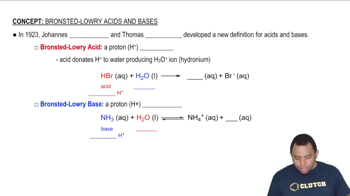
Brønsted–Lowry Acid-Base Theory

The Brønsted–Lowry theory defines acids as proton donors and bases as proton acceptors. This framework allows for the identification of acid-base reactions based on the transfer of protons (H+ ions) between species. Understanding this theory is essential for analyzing reactions and determining the roles of different substances in the reaction.
추천 영상:
가이드 코스
02:08
Bronsted-Lowry Acid-Base Theory

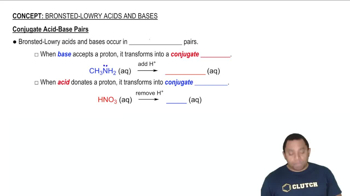
Conjugate Acid-Base Pairs

In the context of Brønsted–Lowry theory, a conjugate acid is formed when a base accepts a proton, while a conjugate base is formed when an acid donates a proton. These pairs are crucial for understanding the equilibrium of acid-base reactions, as they illustrate how substances can interchange roles depending on the reaction conditions.
추천 영상:
가이드 코스
01:30
Conjugate Acid-Base Pairs

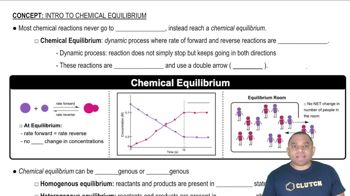
Chemical Equilibrium

Chemical equilibrium refers to the state in which the rates of the forward and reverse reactions are equal, resulting in constant concentrations of reactants and products. In acid-base reactions, this concept helps explain how the presence of acids and bases can shift the equilibrium position, affecting the concentrations of conjugate acids and bases in solution.
추천 영상:
가이드 코스
04:21
Chemical Equilibrium Concepts