Determine the pH of each solution. a. 0.048 M HI b. 0.0895 M HClO4 c. a solution that is 0.045 M in HClO4 and 0.048 M in HCl d. a solution that is 1.09% HCl by mass (assume a density of 1.01 g/mL for the solution)

Ch.16 - Acids and Bases
16장, 문제 59
What mass of HI must be present in 0.250 L of solution to obtain a solution with each pH value?
a. pH = 1.25 b. pH = 1.75 c. pH = 2.85
검증된 단계별 안내1
Determine the concentration of hydrogen ions [H^+] in the solution using the pH value. Use the formula: [H^+] = 10^{-pH}.
Substitute the given pH value (1.75) into the formula to find [H^+].
Recognize that HI is a strong acid and dissociates completely in water, so the concentration of HI is equal to the concentration of [H^+].
Calculate the moles of HI required using the concentration of HI and the volume of the solution (0.250 L). Use the formula: moles of HI = [HI] * volume.
Convert the moles of HI to mass using the molar mass of HI. Use the formula: mass = moles * molar mass of HI.

비슷한 문제에 대한 검증된 영상 답변:
이 영상 해법은 위 문제에 도움이 된다고 튜터들이 추천한 것입니다.
영상 길이:
3m주요 개념
질문에 올바르게 답하기 위해 반드시 이해해야 하는 핵심 개념들은 다음과 같습니다.
pH and Hydrogen Ion Concentration
pH is a measure of the acidity or basicity of a solution, defined as the negative logarithm of the hydrogen ion concentration. A lower pH indicates a higher concentration of hydrogen ions (H+), while a higher pH indicates a lower concentration. For example, a pH of 1.75 corresponds to a hydrogen ion concentration of approximately 0.0178 M.
추천 영상:
가이드 코스
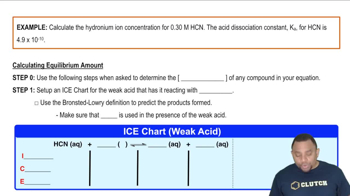
Hydronium Ion Concentration Example
Molarity and Solution Concentration
Molarity (M) is a way to express the concentration of a solution, defined as the number of moles of solute per liter of solution. To find the mass of a solute needed to achieve a specific molarity, one can use the formula: mass = molarity × volume × molar mass. This concept is essential for calculating how much HI is required to reach the desired pH.
추천 영상:
가이드 코스
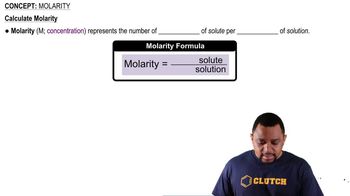
Molarity Concept
Dissociation of HI in Solution
Hydrogen iodide (HI) is a strong acid that completely dissociates in water to produce hydrogen ions (H+) and iodide ions (I-). This complete dissociation means that the concentration of H+ ions in the solution is equal to the concentration of HI initially added. Understanding this dissociation is crucial for determining the amount of HI needed to achieve a specific pH.
추천 영상:
가이드 코스
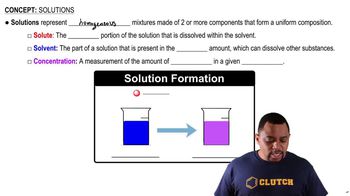
Solution Components
관련 실천
교과서 질문
교과서 질문
What is the pH of a solution in which 224 mL of HCl(g), measured at 27.2 °C and 1.02 atm, is dissolved in 1.5 L of aqueous solution?
1263
views
교과서 질문
For each strong acid solution, determine [H3O+], [OH–], and pH. d. a solution that is 0.655% HNO3 by mass (assume a density of 1.01 g/mL for the solution)
1747
views
교과서 질문
What mass of HClO4 must be present in 0.500 L of solution to obtain a solution with each pH value? a. pH = 2.50 b. pH = 1.50 c. pH = 0.50
1178
views
교과서 질문
For each strong acid solution, determine [H3O+], [OH–], and pH. c. a solution that is 0.052 M in HBr and 0.020 M in HNO3
1008
views