Ch.16 - Acids and Bases
Tro - Chemistry: A Molecular Approach 4th Edition
Tro4th EditionChemistry: A Molecular ApproachISBN: 9780134112831당신이 사용하는 게 아니라요?교과서 변경
16장, 문제 62

What volume of a concentrated HCl solution, which is 36.0% HCl by mass and has a density of 1.179 g/mL, should be used to make 5.00 L of an HCl solution with a pH of 1.8?

검증된 단계별 안내
1
Determine the concentration of the target HCl solution using the pH value. Use the formula \( \text{pH} = -\log[\text{H}^+] \) to find \([\text{H}^+]\).
Calculate the molarity of the target HCl solution. Since \([\text{H}^+]\) is equal to the molarity of HCl, use the value from the previous step.
Calculate the molarity of the concentrated HCl solution. Use the given mass percentage and density to find the molarity: \( \text{Molarity} = \frac{\text{mass percent} \times \text{density} \times 1000}{\text{molar mass of HCl}} \).
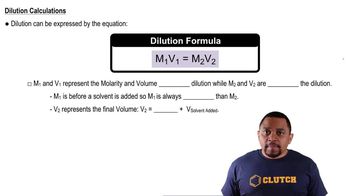
Use the dilution equation \( M_1V_1 = M_2V_2 \) to find the volume \( V_1 \) of the concentrated solution needed. Here, \( M_1 \) is the molarity of the concentrated solution, \( V_1 \) is the volume of the concentrated solution, \( M_2 \) is the molarity of the target solution, and \( V_2 \) is the volume of the target solution.
Solve for \( V_1 \) to find the volume of the concentrated HCl solution required.

주요 개념

질문에 올바르게 답하기 위해 반드시 이해해야 하는 핵심 개념들은 다음과 같습니다.

Concentration and Dilution

Concentration refers to the amount of solute present in a given volume of solution. In this context, diluting a concentrated HCl solution involves mixing it with a solvent (usually water) to achieve a desired concentration. The dilution equation, C1V1 = C2V2, where C is concentration and V is volume, is essential for calculating the volume of concentrated solution needed to achieve a specific concentration in a larger volume.
추천 영상:
가이드 코스
00:58
Dilution Equation

pH and Hydrogen Ion Concentration

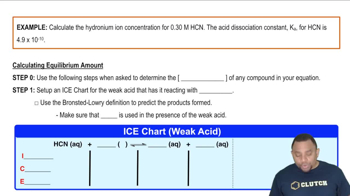
pH is a measure of the acidity or basicity of a solution, defined as the negative logarithm of the hydrogen ion concentration (H+). A pH of 1.8 indicates a relatively high concentration of H+ ions, which can be calculated using the formula [H+] = 10^(-pH). Understanding how to relate pH to H+ concentration is crucial for determining the amount of HCl needed to achieve the desired acidity in the final solution.
추천 영상:
가이드 코스
06:25
Hydronium Ion Concentration Example

Density and Mass-Volume Relationships

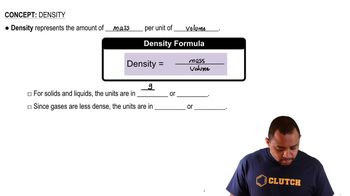
Density is defined as mass per unit volume and is a critical factor in converting between mass and volume of a solution. For the concentrated HCl solution, knowing its density (1.179 g/mL) allows us to calculate the mass of HCl in a given volume. This relationship is important for determining how much of the concentrated solution is required to provide the necessary amount of HCl to achieve the target pH in the final diluted solution.
추천 영상:
가이드 코스
01:56
Density Concepts