Ch.16 - Acids and Bases
Tro - Chemistry: A Molecular Approach 4th Edition
Tro4th EditionChemistry: A Molecular ApproachISBN: 9780134112831당신이 사용하는 게 아니라요?교과서 변경
16장, 문제 37b

Write the formula for the conjugate base of each acid. b. H2SO3

검증된 단계별 안내
1
Identify the acid given in the problem: \( \text{H}_2\text{SO}_3 \).
Recall that a conjugate base is formed by removing one proton (\( \text{H}^+ \)) from the acid.
Remove one \( \text{H}^+ \) from \( \text{H}_2\text{SO}_3 \) to form the conjugate base.
After removing \( \text{H}^+ \), the remaining species is \( \text{HSO}_3^- \).
Thus, the formula for the conjugate base of \( \text{H}_2\text{SO}_3 \) is \( \text{HSO}_3^- \).

비슷한 문제에 대한 검증된 영상 답변:

이 영상 해법은 위 문제에 도움이 된다고 튜터들이 추천한 것입니다.
영상 길이:
1m
도움이 되었나요?

주요 개념

질문에 올바르게 답하기 위해 반드시 이해해야 하는 핵심 개념들은 다음과 같습니다.

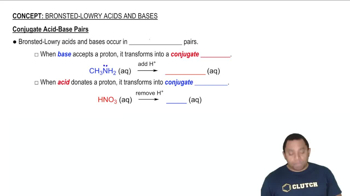
Conjugate Acid-Base Pairs

In acid-base chemistry, a conjugate base is formed when an acid donates a proton (H+). The relationship between an acid and its conjugate base is fundamental to understanding acid-base reactions, as it illustrates how substances can interchange between donating and accepting protons.
추천 영상:
가이드 코스
01:30
Conjugate Acid-Base Pairs

Sulfurous Acid (H2SO3)

Sulfurous acid (H2SO3) is a weak diprotic acid that can donate two protons. When it loses one proton, it forms its conjugate base, bisulfite (HSO3-), and if it loses both protons, it forms sulfite (SO3^2-). Understanding the structure and behavior of sulfurous acid is essential for identifying its conjugate base.
추천 영상:

Acid-Base Equilibrium

Acid-base equilibrium refers to the balance between acids and their conjugate bases in solution. This concept is crucial for predicting the direction of acid-base reactions and understanding the strength of acids and bases, which is determined by their ability to donate or accept protons in a chemical reaction.
추천 영상:
가이드 코스
6:47
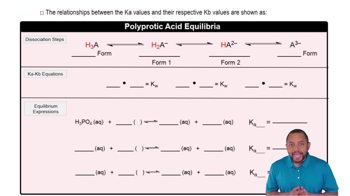
Triprotic Acid Equilibrium