Ch.17 - Aqueous Ionic Equilibrium

Tro4th EditionChemistry: A Molecular ApproachISBN: 9780134112831
당신이 사용하는 게 아니라요?교과서 변경다른 교과서를 선택하세요
TOC.tableOfContents
- Ch.1 - Matter, Measurement & Problem Solving136
- Ch.2 - Atoms & Elements112
- Ch.3 - Molecules, Compounds & Chemical Equations159
- Ch.4 - Chemical Quantities & Aqueous Reactions140
- Ch.5 - Gases118
- Ch.6 - Thermochemistry106
- Ch.7 - Quantum-Mechanical Model of the Atom62
- Ch.8 - Periodic Properties of the Elements103
- Ch.9 - Chemical Bonding I: The Lewis Model104
- Ch.10 - Chemical Bonding II: Molecular Shapes & Valence Bond Theory89
- Ch.11 - Liquids, Solids & Intermolecular Forces73
- Ch.12 - Solids and Modern Material59
- Ch.13 - Solutions110
- Ch.14 - Chemical Kinetics140
- Ch.15 - Chemical Equilibrium78
- Ch.16 - Acids and Bases155
- Ch.17 - Aqueous Ionic Equilibrium176
- Ch.18 - Free Energy and Thermodynamics108
- Ch.19 - Electrochemistry118
- Ch.20 - Radioactivity and Nuclear Chemistry82
- Ch.21 - Organic Chemistry150

17장, 문제 7
A 15.0-mL sample of 0.100 M Ba(OH)2 is titrated with 0.125 M HCl. Calculate the pH for at least five different points throughout the titration curve and sketch the curve. Indicate the volume at the equivalence point on your graph.
 검증된 단계별 안내
1
insert step 1: Determine the initial pH of the Ba(OH)_2 solution before any HCl is added. Calculate the concentration of OH^- ions using the formula [OH^-] = 2 * [Ba(OH)_2] because each Ba(OH)_2 dissociates into two OH^- ions. Then, find the pOH and convert it to pH using pH + pOH = 14.
insert step 2: Calculate the pH after adding a small volume of HCl, such as 5.0 mL. Determine the moles of HCl added and the moles of OH^- initially present. Subtract the moles of HCl from the moles of OH^- to find the remaining moles of OH^-. Calculate the new concentration of OH^- and find the pH.
insert step 3: Determine the pH at the equivalence point. At this point, all the OH^- ions have reacted with HCl, forming water and BaCl_2. Calculate the volume of HCl needed to reach the equivalence point using the stoichiometry of the reaction. Since the solution is neutral at the equivalence point, the pH is 7.
insert step 4: Calculate the pH after adding a volume of HCl beyond the equivalence point, such as 20.0 mL. Determine the excess moles of HCl and calculate the concentration of H^+ ions in the solution. Use this concentration to find the pH.
insert step 5: Sketch the titration curve using the calculated pH values at different points. Label the initial pH, the pH at the equivalence point, and the pH after adding excess HCl. Indicate the volume of HCl at the equivalence point on the graph.
주요 개념
질문에 올바르게 답하기 위해 반드시 이해해야 하는 핵심 개념들은 다음과 같습니다.
Titration
Titration is a quantitative analytical technique used to determine the concentration of a solute in a solution. It involves the gradual addition of a titrant (a solution of known concentration) to a sample solution until the reaction reaches its equivalence point, where the amount of titrant equals the amount of substance in the sample. Understanding the titration process is essential for calculating pH changes at various points during the titration.
추천 영상:
가이드 코스
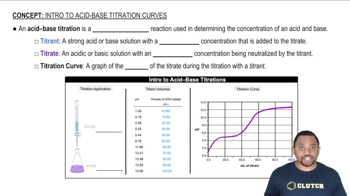
 03:04
03:04
Acid-Base Titration
Equivalence Point
The equivalence point in a titration is the stage at which the amount of titrant added is stoichiometrically equivalent to the amount of substance present in the sample solution. For the titration of Ba(OH)2 with HCl, this point occurs when all the barium hydroxide has reacted with hydrochloric acid, resulting in a neutralization reaction. Identifying the equivalence point is crucial for determining the pH and understanding the overall titration curve.
추천 영상:
가이드 코스
 01:07
01:07At the Equivalence Point
pH Calculation
pH is a measure of the acidity or basicity of a solution, defined as the negative logarithm of the hydrogen ion concentration. During a titration, pH changes can be calculated at various points by considering the concentrations of the reactants and products formed. For strong acid-strong base titrations, the pH at the equivalence point is typically around 7, while before and after this point, the pH will vary significantly, reflecting the dominance of either the acid or base.
추천 영상:
가이드 코스
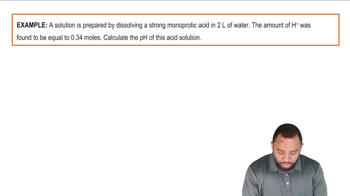 02:15
02:15pH Calculation Example
관련 실천