Ch.17 - Aqueous Ionic Equilibrium

Tro4th EditionChemistry: A Molecular ApproachISBN: 9780134112831
당신이 사용하는 게 아니라요?교과서 변경다른 교과서를 선택하세요
TOC.tableOfContents
- Ch.1 - Matter, Measurement & Problem Solving136
- Ch.2 - Atoms & Elements112
- Ch.3 - Molecules, Compounds & Chemical Equations159
- Ch.4 - Chemical Quantities & Aqueous Reactions140
- Ch.5 - Gases118
- Ch.6 - Thermochemistry106
- Ch.7 - Quantum-Mechanical Model of the Atom62
- Ch.8 - Periodic Properties of the Elements103
- Ch.9 - Chemical Bonding I: The Lewis Model104
- Ch.10 - Chemical Bonding II: Molecular Shapes & Valence Bond Theory89
- Ch.11 - Liquids, Solids & Intermolecular Forces73
- Ch.12 - Solids and Modern Material59
- Ch.13 - Solutions110
- Ch.14 - Chemical Kinetics140
- Ch.15 - Chemical Equilibrium78
- Ch.16 - Acids and Bases155
- Ch.17 - Aqueous Ionic Equilibrium176
- Ch.18 - Free Energy and Thermodynamics108
- Ch.19 - Electrochemistry118
- Ch.20 - Radioactivity and Nuclear Chemistry82
- Ch.21 - Organic Chemistry150

17장, 문제 137
What should the molar concentrations of benzoic acid and sodium benzoate be in a solution that is buffered at a pH of 4.55 and has a freezing point of -2.0 °C? (Assume complete dissociation of sodium benzoate and a density of 1.01 g/mL for the solution.)
 검증된 단계별 안내
1
Step 1: Identify the relevant equations. The Henderson-Hasselbalch equation, which is pH = pKa + log([A-]/[HA]), will be used to find the ratio of the concentrations of the benzoate ion ([A-]) to benzoic acid ([HA]). The freezing point depression equation, ΔTf = Kf * m, will be used to find the total molality of the solution.
Step 2: Use the Henderson-Hasselbalch equation to find the ratio of the concentrations of the benzoate ion to benzoic acid. The pKa of benzoic acid is 4.20, so you can plug in the given pH and pKa into the equation to solve for the ratio [A-]/[HA].
Step 3: Use the freezing point depression equation to find the total molality of the solution. The freezing point depression constant (Kf) for water is 1.86 °C/m. You can plug in the given freezing point depression and Kf into the equation to solve for the molality (m).
Step 4: Convert the total molality to total molarity. To do this, you need to use the density of the solution. The equation to convert molality to molarity is M = m * (density/(1 + m * MW)), where MW is the average molecular weight of the solutes.
Step 5: Use the ratio from step 2 and the total molarity from step 4 to find the individual molar concentrations of benzoic acid and sodium benzoate. The sum of the molar concentrations of benzoic acid and sodium benzoate should equal the total molarity. Solve for the individual molar concentrations using the ratio and the total molarity.
비슷한 문제에 대한 검증된 영상 답변:
이 영상 해법은 위 문제에 도움이 된다고 튜터들이 추천한 것입니다.

영상 길이:
7m주요 개념
질문에 올바르게 답하기 위해 반드시 이해해야 하는 핵심 개념들은 다음과 같습니다.
Buffer Solutions
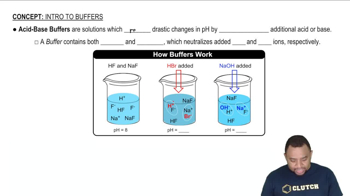
A buffer solution is a system that resists changes in pH upon the addition of small amounts of acid or base. It typically consists of a weak acid and its conjugate base, which in this case are benzoic acid and sodium benzoate. The Henderson-Hasselbalch equation can be used to calculate the ratio of these components needed to achieve a specific pH.
추천 영상:
가이드 코스
 03:02
03:02
Buffer Solutions
Henderson-Hasselbalch Equation
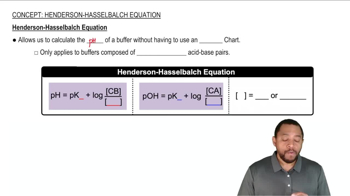
The Henderson-Hasselbalch equation relates the pH of a buffer solution to the concentrations of its acid and conjugate base. It is expressed as pH = pKa + log([A-]/[HA]), where pKa is the acid dissociation constant. This equation allows for the determination of the required molar concentrations of benzoic acid and sodium benzoate to achieve the desired pH of 4.55.
추천 영상:
가이드 코스
 02:40
02:40Henderson-Hasselbalch Equation
Freezing Point Depression
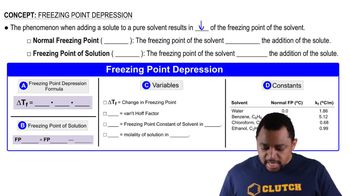
Freezing point depression is a colligative property that describes how the freezing point of a solvent decreases when a solute is added. The extent of freezing point depression can be calculated using the formula ΔTf = i * Kf * m, where ΔTf is the change in freezing point, Kf is the freezing point depression constant, and m is the molality of the solution. This concept is essential for understanding how the concentrations of benzoic acid and sodium benzoate affect the solution's freezing point.
추천 영상:
가이드 코스
 01:59
01:59Freezing Point Depression
관련 실천