Consider the reaction: I2(g) + Cl2(g) ⇌ 2 ICl(g) Kp = 81.9 at 25 °C Calculate ΔGrxn for the reaction at 25 °C under each of the following conditions: a. standard conditions
Ch.18 - Free Energy and Thermodynamics
18장, 문제 77
Is the value of the equilibrium constant at 525 K for each reaction in Problem 73 estimated correctly?
검증된 단계별 안내1
insert step 1> Identify the reactions from Problem 73 that need to be evaluated for their equilibrium constants at 525 K.
insert step 2> Review the method used to estimate the equilibrium constant for each reaction. This could involve calculations using the Van't Hoff equation or other thermodynamic data.
insert step 3> Check if the temperature dependence of the equilibrium constant was considered correctly. This often involves using the Van't Hoff equation: \( \ln \frac{K_2}{K_1} = -\frac{\Delta H^\circ}{R} \left( \frac{1}{T_2} - \frac{1}{T_1} \right) \), where \( \Delta H^\circ \) is the standard enthalpy change, \( R \) is the gas constant, and \( T_1 \) and \( T_2 \) are the initial and final temperatures, respectively.
insert step 4> Verify if the correct values for \( \Delta H^\circ \) and \( K_1 \) (the equilibrium constant at the initial temperature) were used in the calculations.
insert step 5> Compare the estimated equilibrium constants with any available experimental data or literature values to assess the accuracy of the estimates.
주요 개념
질문에 올바르게 답하기 위해 반드시 이해해야 하는 핵심 개념들은 다음과 같습니다.
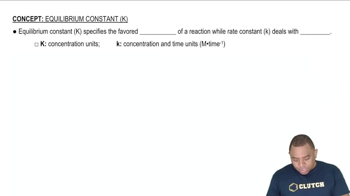
Equilibrium Constant (K)
The equilibrium constant (K) is a numerical value that expresses the ratio of the concentrations of products to reactants at equilibrium for a given reaction at a specific temperature. It provides insight into the extent of a reaction and whether it favors products or reactants. A larger K value indicates a greater concentration of products at equilibrium, while a smaller K suggests a predominance of reactants.
추천 영상:
가이드 코스
Equilibrium Constant K
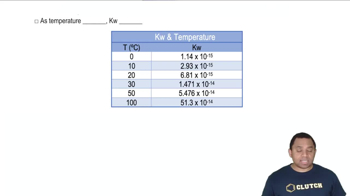
Temperature Dependence of K
The value of the equilibrium constant is temperature-dependent, meaning it can change with variations in temperature. According to Le Chatelier's principle, if a reaction is exothermic, increasing the temperature will decrease the value of K, while for endothermic reactions, increasing temperature will increase K. Understanding this relationship is crucial for accurately estimating K at different temperatures.
추천 영상:
가이드 코스
Kw Temperature Dependence
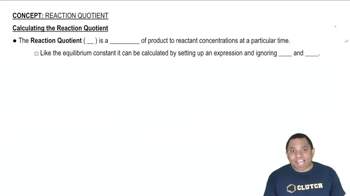
Reaction Quotient (Q)
The reaction quotient (Q) is a measure of the relative concentrations of products and reactants at any point in time during a reaction. It is calculated using the same formula as K but with concentrations that are not necessarily at equilibrium. Comparing Q to K helps predict the direction in which a reaction will proceed to reach equilibrium, which is essential for evaluating the correctness of K values in specific conditions.
추천 영상:
가이드 코스
Reaction Quotient Q
관련 실천
교과서 질문
811
views
교과서 질문
Consider the reaction: I2(g) + Cl2(g) ⇌ 2 ICl(g) Kp = 81.9 at 25 °C Calculate ΔGrxn for the reaction at 25 °C under each of the following conditions: b. at equilibrium
977
views
교과서 질문
Consider the reaction: 2 NO(g) + O2(g) ⇌ 2 NO2(g) The following data show the equilibrium constant for this reaction measured at several different temperatures. Use the data to find ΔH°rxn and ΔS°rxn for the reaction.
1156
views
1
comments
교과서 질문
Consider the reaction: I2(g) + Cl2(g) ⇌ 2 ICl(g) Kp = 81.9 at 25 °C Calculate ΔGrxn for the reaction at 25 °C under each of the following conditions: c. PICl = 2.55 atm; PI2 = 0.325 atm; PCl2 = 0.221 atm
2862
views