Ch.18 - Free Energy and Thermodynamics
Tro - Chemistry: A Molecular Approach 4th Edition
Tro4th EditionChemistry: A Molecular ApproachISBN: 9780134112831당신이 사용하는 게 아니라요?교과서 변경
18장, 문제 88

H2 reacts with the halogens (X2) according to the reaction: H2(g) + X2(g) → 2 HX(g) where X2 can be Cl2, Br2, or I2. Use the thermodynamic data in Appendix IIB to calculate ΔH°, ΔS°, ΔG°, and Kp for the reaction between hydrogen and each of the three halogens. Which reaction is most spontaneous? Least spontaneous? What is the main factor responsible for the difference in the spontaneity of the three reactions? Does higher temperature make the reactions more spontaneous or less spontaneous?

검증된 단계별 안내
1
Identify the thermodynamic data needed for each reaction: \( \Delta H^\circ_f \), \( \Delta S^\circ \), and \( \Delta G^\circ_f \) for each reactant and product from Appendix IIB.
Calculate \( \Delta H^\circ \) for each reaction using the formula: \( \Delta H^\circ = \sum \Delta H^\circ_f(\text{products}) - \sum \Delta H^\circ_f(\text{reactants}) \).
Calculate \( \Delta S^\circ \) for each reaction using the formula: \( \Delta S^\circ = \sum \Delta S^\circ(\text{products}) - \sum \Delta S^\circ(\text{reactants}) \).
Calculate \( \Delta G^\circ \) for each reaction using the formula: \( \Delta G^\circ = \Delta H^\circ - T\Delta S^\circ \), where \( T \) is the temperature in Kelvin.
Determine \( K_p \) for each reaction using the relationship: \( \Delta G^\circ = -RT \ln K_p \), and compare the spontaneity of the reactions by analyzing \( \Delta G^\circ \) and \( K_p \).

주요 개념

질문에 올바르게 답하기 위해 반드시 이해해야 하는 핵심 개념들은 다음과 같습니다.

Thermodynamic Functions

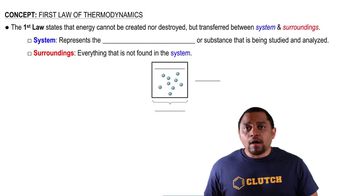
Thermodynamic functions such as enthalpy (ΔH°), entropy (ΔS°), and Gibbs free energy (ΔG°) are essential for understanding chemical reactions. ΔH° indicates the heat absorbed or released during a reaction, while ΔS° measures the change in disorder. ΔG° combines these two to determine the spontaneity of a reaction; a negative ΔG° indicates a spontaneous process. Understanding these functions helps predict how reactions will behave under different conditions.
추천 영상:
가이드 코스
01:18
First Law of Thermodynamics

Equilibrium Constant (Kp)

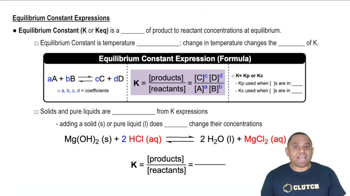
The equilibrium constant (Kp) quantifies the ratio of the concentrations of products to reactants at equilibrium for a given reaction. For the reaction H2 + X2 → 2HX, Kp can be calculated using the partial pressures of the gases involved. A larger Kp value indicates a greater tendency for the reaction to favor product formation, which is closely related to the spontaneity of the reaction. Understanding Kp is crucial for analyzing how changes in conditions affect reaction outcomes.
추천 영상:
가이드 코스
03:20
Equilibrium Constant Expressions

Effect of Temperature on Spontaneity

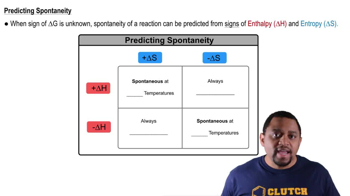
Temperature plays a significant role in the spontaneity of chemical reactions, as described by the Gibbs free energy equation: ΔG° = ΔH° - TΔS°. An increase in temperature can enhance the spontaneity of reactions with positive ΔS° (increased disorder) by reducing ΔG°. Conversely, for reactions with negative ΔS°, higher temperatures may make them less spontaneous. Thus, analyzing the temperature's effect is vital for understanding the behavior of the reactions between hydrogen and halogens.
추천 영상:
가이드 코스
01:17
Spontaneity and Temperature