
Nitrogen dioxide, a pollutant in the atmosphere, can combine with water to form nitric acid. One of the possible reactions is shown here. Calculate ΔG° and Kp for this reaction at 25 °C and comment on the spontaneity of the reaction. 3 NO2(g) + H2O(l)→ 2 HNO3(aq) + NO(g)
Ch.18 - Free Energy and Thermodynamics
18장, 문제 89a
Consider this reaction occurring at 298 K: N2O(g) + NO2(g) ⇌ 3 NO(g) a. Show that the reaction is not spontaneous under standard conditions by calculating ΔG°rxn.
검증된 단계별 안내1
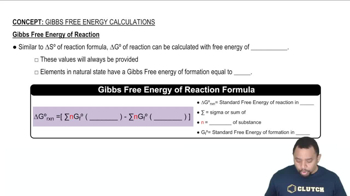
insert step 1> Calculate the standard Gibbs free energy of formation (ΔG°f) for each species involved in the reaction using a standard table of thermodynamic values.
insert step 2> Use the equation ΔG°rxn = ΣΔG°f(products) - ΣΔG°f(reactants) to find the standard Gibbs free energy change for the reaction.
insert step 3> Substitute the ΔG°f values for NO, N2O, and NO2 into the equation. Remember to multiply the ΔG°f of NO by 3, as there are 3 moles of NO produced.
insert step 4> Calculate the sum of the ΔG°f values for the products and the reactants separately.
insert step 5> Subtract the sum of the reactants' ΔG°f from the sum of the products' ΔG°f to find ΔG°rxn. If ΔG°rxn is positive, the reaction is not spontaneous under standard conditions.

비슷한 문제에 대한 검증된 영상 답변:
이 영상 해법은 위 문제에 도움이 된다고 튜터들이 추천한 것입니다.
영상 길이:
7m주요 개념
질문에 올바르게 답하기 위해 반드시 이해해야 하는 핵심 개념들은 다음과 같습니다.
Gibbs Free Energy (ΔG)
Gibbs Free Energy (ΔG) is a thermodynamic potential that measures the maximum reversible work obtainable from a thermodynamic system at constant temperature and pressure. A negative ΔG indicates that a reaction is spontaneous, while a positive ΔG suggests non-spontaneity. The standard Gibbs free energy change (ΔG°) is calculated using standard state conditions, which allows for the comparison of different reactions.
추천 영상:
가이드 코스
Gibbs Free Energy of Reactions
Standard Conditions
Standard conditions refer to a set of specific conditions used to measure and compare the properties of substances, typically defined as 1 bar of pressure and a specified temperature, usually 298 K (25 °C). Under these conditions, the standard enthalpy, entropy, and Gibbs free energy values are determined, providing a consistent basis for evaluating the spontaneity of reactions and their thermodynamic favorability.
추천 영상:
가이드 코스
Standard Reduction Potentials
Equilibrium Constant (K)
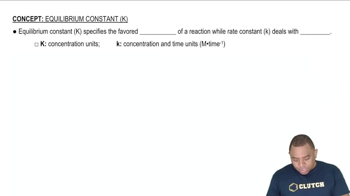
The equilibrium constant (K) is a dimensionless value that expresses the ratio of the concentrations of products to reactants at equilibrium for a given reaction at a specific temperature. It is related to the Gibbs free energy change by the equation ΔG° = -RT ln(K), where R is the universal gas constant and T is the temperature in Kelvin. A K value less than 1 indicates that reactants are favored at equilibrium, which correlates with a positive ΔG°, suggesting the reaction is not spontaneous under standard conditions.
추천 영상:
가이드 코스
Equilibrium Constant K
관련 실천
교과서 질문
1274
views
교과서 질문
Consider this reaction occurring at 298 K: N2O(g) + NO2(g) ⇌ 3 NO(g) c. Can the reaction be made more spontaneous by an increase or decrease in temperature? If so, what temperature is required to make the reaction spontaneous under standard conditions?
499
views
교과서 질문
Consider this reaction occurring at 298 K: N2O(g) + NO2(g) ⇌ 3 NO(g) b. If a reaction mixture contains only N2O and NO2 at partial pressures of 1.0 atm each, the reaction will be spontaneous until some NO forms in the mixture. What maximum partial pressure of NO builds up before the reaction ceases to be spontaneous?
1806
views
교과서 질문
Consider this reaction occurring at 298 K: BaCO3(s) ⇌ BaO(s) + CO2(g) a. Show that the reaction is not spontaneous under standard conditions by calculating ΔG°rxn.
391
views
