Ch.18 - Free Energy and Thermodynamics
Tro - Chemistry: A Molecular Approach 4th Edition
Tro4th EditionChemistry: A Molecular ApproachISBN: 9780134112831당신이 사용하는 게 아니라요?교과서 변경
18장, 문제 99

Is the sign of ΔSuniv for each process positive or negative? Explain for the following: b. the electrolysis of H2O(l) to H2(g) and O2(g) at 298 K c. the growth of an oak tree from a little acorn.

검증된 단계별 안내
1
insert step 1> Identify the processes involved in each scenario. For part b, the process is the electrolysis of water, and for part c, it is the growth of an oak tree from an acorn.
insert step 2> Recall the second law of thermodynamics, which states that the entropy of the universe (ΔS_{univ}) increases for spontaneous processes.
insert step 3> For part b, consider the electrolysis of water: 2H_2O(l) \(\rightarrow\) 2H_2(g) + O_2(g). This process involves breaking bonds in water molecules to form hydrogen and oxygen gases, which increases the disorder or entropy of the system.
insert step 4> For part c, consider the growth of an oak tree: This process involves organizing simple molecules into complex structures, which decreases the entropy of the system. However, the overall entropy change of the universe must be considered, including the surroundings.
insert step 5> Determine the sign of ΔS_{univ} for each process by considering the changes in entropy of the system and surroundings. For part b, the increase in gas molecules suggests a positive ΔS_{univ}. For part c, the decrease in system entropy is offset by energy exchanges with the surroundings, potentially leading to a positive ΔS_{univ} if the process is spontaneous.

주요 개념

질문에 올바르게 답하기 위해 반드시 이해해야 하는 핵심 개념들은 다음과 같습니다.

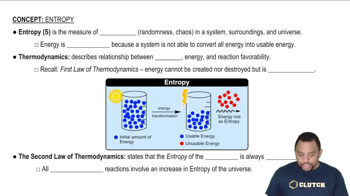
Entropy (ΔS)

Entropy is a measure of the disorder or randomness in a system. In thermodynamics, the change in entropy (ΔS) can indicate whether a process is spontaneous. A positive ΔS suggests an increase in disorder, while a negative ΔS indicates a decrease in disorder. Understanding how entropy changes during a process is crucial for determining the sign of ΔSuniv.
추천 영상:
가이드 코스
02:46
Entropy in Thermodynamics

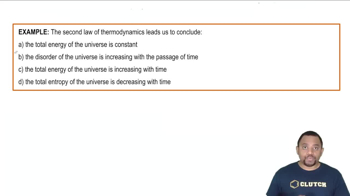
Second Law of Thermodynamics

The Second Law of Thermodynamics states that the total entropy of an isolated system can never decrease over time. It implies that natural processes tend to move towards a state of maximum disorder or entropy. This law is essential for analyzing processes like electrolysis and biological growth, as it helps predict whether the overall entropy change (ΔSuniv) will be positive or negative.
추천 영상:
가이드 코스
00:48
Second Law of Thermodynamics Example

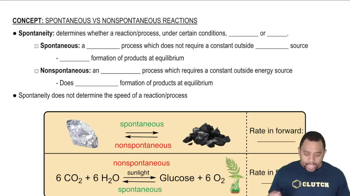
Spontaneity of Processes

A process is considered spontaneous if it occurs without external intervention, often associated with a positive change in the universe's entropy (ΔSuniv > 0). For the electrolysis of water, the process is non-spontaneous under standard conditions, while the growth of an oak tree is a spontaneous biological process. Evaluating spontaneity involves analyzing both the system and surroundings to determine the overall entropy change.
추천 영상:
가이드 코스
04:20
Spontaneity of Processes