
Ch.18 - Free Energy and Thermodynamics
Tro - Chemistry: A Molecular Approach 4th Edition
Tro4th EditionChemistry: A Molecular ApproachISBN: 9780134112831당신이 사용하는 게 아니라요?교과서 변경
18장, 문제 99a

Indicate and explain the sign of ΔSuniv for each process. a. 2 H2(g) + O2(g) → 2 H2O (l) at 298 K.

검증된 단계별 안내
1
Step 1: Understand the concept of entropy (ΔS). Entropy is a measure of the randomness or disorder of a system. The second law of thermodynamics states that the total entropy of an isolated system can never decrease over time, and is constant if and only if all processes are reversible. Isolated systems spontaneously evolve towards thermodynamic equilibrium, the state with maximum entropy.
Step 2: Identify the state of the reactants and products. In this reaction, gaseous reactants (2 H2 and O2) are converted into a liquid product (2 H2O).
Step 3: Consider the change in entropy of the system (ΔSsys). The conversion of gas molecules to liquid molecules results in a decrease in randomness, as molecules in a liquid are more ordered than in a gas. Therefore, the entropy of the system decreases (ΔSsys is negative).
Step 4: Consider the change in entropy of the surroundings (ΔSsurr). The reaction is exothermic, meaning it releases heat into the surroundings. This increases the randomness of the surroundings, so the entropy of the surroundings increases (ΔSsurr is positive).
Step 5: Calculate the total change in entropy (ΔSuniv = ΔSsys + ΔSsurr). If the increase in entropy of the surroundings is greater than the decrease in entropy of the system, the total entropy of the universe increases (ΔSuniv is positive), and the process is spontaneous. If not, the total entropy of the universe decreases (ΔSuniv is negative), and the process is non-spontaneous. In this case, you would need to calculate the specific values of ΔSsys and ΔSsurr to determine the sign of ΔSuniv.

비슷한 문제에 대한 검증된 영상 답변:

이 영상 해법은 위 문제에 도움이 된다고 튜터들이 추천한 것입니다.
영상 길이:
2m

주요 개념

질문에 올바르게 답하기 위해 반드시 이해해야 하는 핵심 개념들은 다음과 같습니다.

Entropy (ΔS)

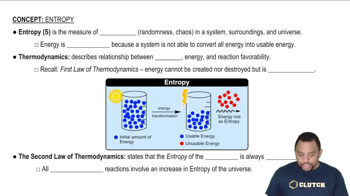
Entropy is a measure of the disorder or randomness in a system. In thermodynamics, a positive change in entropy (ΔS > 0) indicates an increase in disorder, while a negative change (ΔS < 0) signifies a decrease in disorder. Understanding how entropy changes during a chemical reaction is crucial for predicting the spontaneity of the process.
추천 영상:
가이드 코스
02:46
Entropy in Thermodynamics

Second Law of Thermodynamics

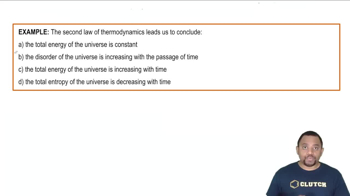
The Second Law of Thermodynamics states that the total entropy of an isolated system can never decrease over time. It implies that natural processes tend to move towards a state of maximum disorder or entropy. This law is fundamental in determining the sign of the change in the universe's entropy (ΔS_univ) during a reaction, as it combines the entropy changes of both the system and its surroundings.
추천 영상:
가이드 코스
00:48
Second Law of Thermodynamics Example

Gibbs Free Energy (ΔG)

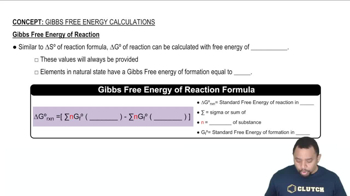
Gibbs Free Energy is a thermodynamic potential that helps predict the direction of chemical reactions and phase changes. It is defined as ΔG = ΔH - TΔS, where ΔH is the change in enthalpy, T is the temperature in Kelvin, and ΔS is the change in entropy. A negative ΔG indicates a spontaneous process, which is closely related to the signs of ΔS and ΔH, making it essential for analyzing the reaction's feasibility.
추천 영상:
가이드 코스
01:51
Gibbs Free Energy of Reactions