
For each reaction, calculate ΔH°rxn, ΔS°rxn, and ΔG°rxn at 25 °C and state whether or not the reaction is spontaneous. If the reaction is not spontaneous, would a change in temperature make it spontaneous? If so, should the temperature be raised or lowered from 25 °C? a. N2O4(g) → 2 NO2(g)
Ch.18 - Free Energy and Thermodynamics
18장, 문제 59
Methanol (CH3OH) burns in oxygen to form carbon dioxide and water. Write a balanced equation for the combustion of liquid methanol and calculate ΔH°rxn, ΔS°rxn, and ΔG°rxn at 25 °C. Is the combustion of methanol spontaneous?
검증된 단계별 안내1
Write the unbalanced chemical equation for the combustion of methanol: \( \text{CH}_3\text{OH} + \text{O}_2 \rightarrow \text{CO}_2 + \text{H}_2\text{O} \).
Balance the chemical equation by ensuring the number of atoms of each element is the same on both sides: \( 2\text{CH}_3\text{OH} + 3\text{O}_2 \rightarrow 2\text{CO}_2 + 4\text{H}_2\text{O} \).
Use standard enthalpies of formation to calculate \( \Delta H^\circ_{\text{rxn}} \) using the formula: \( \Delta H^\circ_{\text{rxn}} = \sum \Delta H^\circ_{\text{f,products}} - \sum \Delta H^\circ_{\text{f,reactants}} \).
Calculate \( \Delta S^\circ_{\text{rxn}} \) using standard molar entropies: \( \Delta S^\circ_{\text{rxn}} = \sum S^\circ_{\text{products}} - \sum S^\circ_{\text{reactants}} \).
Determine \( \Delta G^\circ_{\text{rxn}} \) using the Gibbs free energy equation: \( \Delta G^\circ_{\text{rxn}} = \Delta H^\circ_{\text{rxn}} - T\Delta S^\circ_{\text{rxn}} \), and assess spontaneity by checking if \( \Delta G^\circ_{\text{rxn}} < 0 \).

비슷한 문제에 대한 검증된 영상 답변:
이 영상 해법은 위 문제에 도움이 된다고 튜터들이 추천한 것입니다.
도움이 되었나요?
주요 개념
질문에 올바르게 답하기 위해 반드시 이해해야 하는 핵심 개념들은 다음과 같습니다.
Combustion Reactions
Combustion reactions are exothermic processes where a substance reacts with oxygen to produce heat, light, carbon dioxide, and water. In the case of methanol (CH3OH), the balanced equation for its combustion involves the complete reaction with oxygen to yield carbon dioxide (CO2) and water (H2O). Understanding how to balance these equations is crucial for stoichiometric calculations and thermodynamic assessments.
추천 영상:
가이드 코스
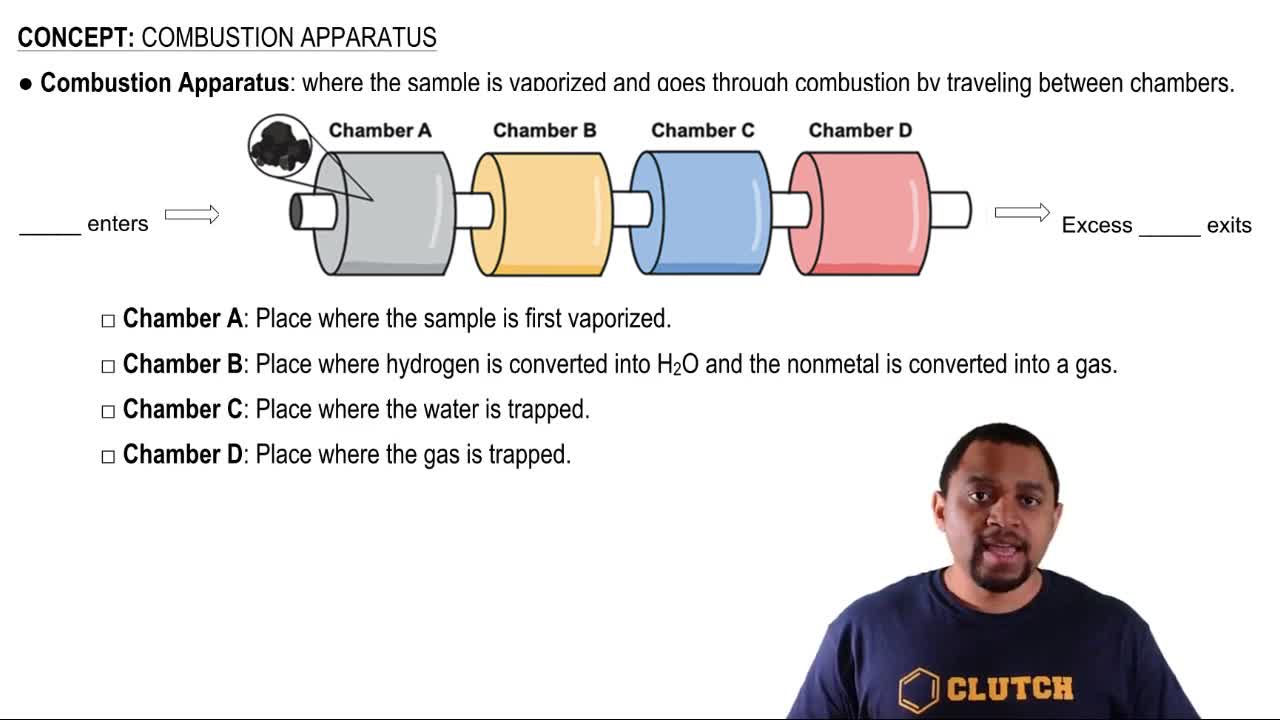
Combustion Apparatus
Thermodynamics: ΔH°, ΔS°, and ΔG°
Thermodynamics involves the study of energy changes in chemical reactions. ΔH° (enthalpy change) indicates the heat absorbed or released, ΔS° (entropy change) measures the disorder or randomness in the system, and ΔG° (Gibbs free energy change) determines the spontaneity of the reaction. A negative ΔG° suggests that the reaction is spontaneous under standard conditions, which is essential for evaluating the combustion of methanol.
추천 영상:
가이드 코스
First Law of Thermodynamics
Spontaneity of Reactions
The spontaneity of a reaction refers to its ability to occur without external intervention. It is determined by the sign of ΔG°; if ΔG° is negative, the reaction is spontaneous. Factors influencing spontaneity include enthalpy and entropy changes, where a highly exothermic reaction with a significant increase in entropy is likely to be spontaneous, as is the case with the combustion of methanol.
추천 영상:
가이드 코스
Spontaneity of Processes
관련 실천
교과서 질문
731
views
교과서 질문
Find ΔS° for the formation of CH2Cl2(g) from its gaseous elements in their standard states. Rationalize the sign of ΔS°.
1957
views
1
comments
교과서 질문
In photosynthesis, plants form glucose (C6H12O6) and oxygen from carbon dioxide and water. Write a balanced equation for photosynthesis and calculate ΔH°rxn, ΔS°rxn, and ΔG°rxn at 25 °C. Is photosynthesis spontaneous?
3209
views
교과서 질문
Use data from Appendix IIB to calculate ΔS°rxn for each of the reactions. In each case, try to rationalize the sign of ΔS°rxn. d. N2O4(g) + 4 H2(g) → N2(g) + 4 H2O(g)
340
views
