Ch.18 - Free Energy and Thermodynamics
Tro - Chemistry: A Molecular Approach 4th Edition
Tro4th EditionChemistry: A Molecular ApproachISBN: 9780134112831당신이 사용하는 게 아니라요?교과서 변경
18장, 문제 100

The Haber process is very important for agriculture because it converts N2(g) from the atmosphere into bound nitrogen, which can be taken up and used by plants. The Haber process reaction is N2(g) + 3 H2(g) → 2 NH3(g). The reaction is exothermic but is carried out at relatively high temperatures. Why?

검증된 단계별 안내
1
Understand the Haber process: The Haber process synthesizes ammonia (NH3) from nitrogen (N2) and hydrogen (H2) gases. The balanced chemical equation is N2(g) + 3 H2(g) → 2 NH3(g).
Recognize the nature of the reaction: The reaction is exothermic, meaning it releases heat.
Consider the effect of temperature on reaction rate: Higher temperatures increase the kinetic energy of molecules, leading to more frequent and effective collisions, thus increasing the reaction rate.
Apply Le Chatelier's Principle: Although the reaction is exothermic, increasing the temperature shifts the equilibrium position to favor the reactants (N2 and H2). However, high temperatures are used to achieve a reasonable reaction rate despite this shift.
Balance between rate and yield: The process is carried out at high temperatures to ensure a faster reaction rate, even though it slightly reduces the yield of ammonia due to the equilibrium shift.

주요 개념

질문에 올바르게 답하기 위해 반드시 이해해야 하는 핵심 개념들은 다음과 같습니다.

Haber Process

The Haber process is a chemical reaction that synthesizes ammonia (NH3) from nitrogen (N2) and hydrogen (H2) gases. This process is crucial for producing fertilizers, which are essential for modern agriculture. The reaction is represented by the equation N2(g) + 3 H2(g) → 2 NH3(g), highlighting the stoichiometric relationship between the reactants and products.
추천 영상:
가이드 코스
03:49
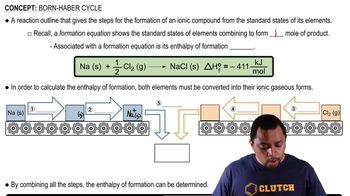
Born Haber Cycle

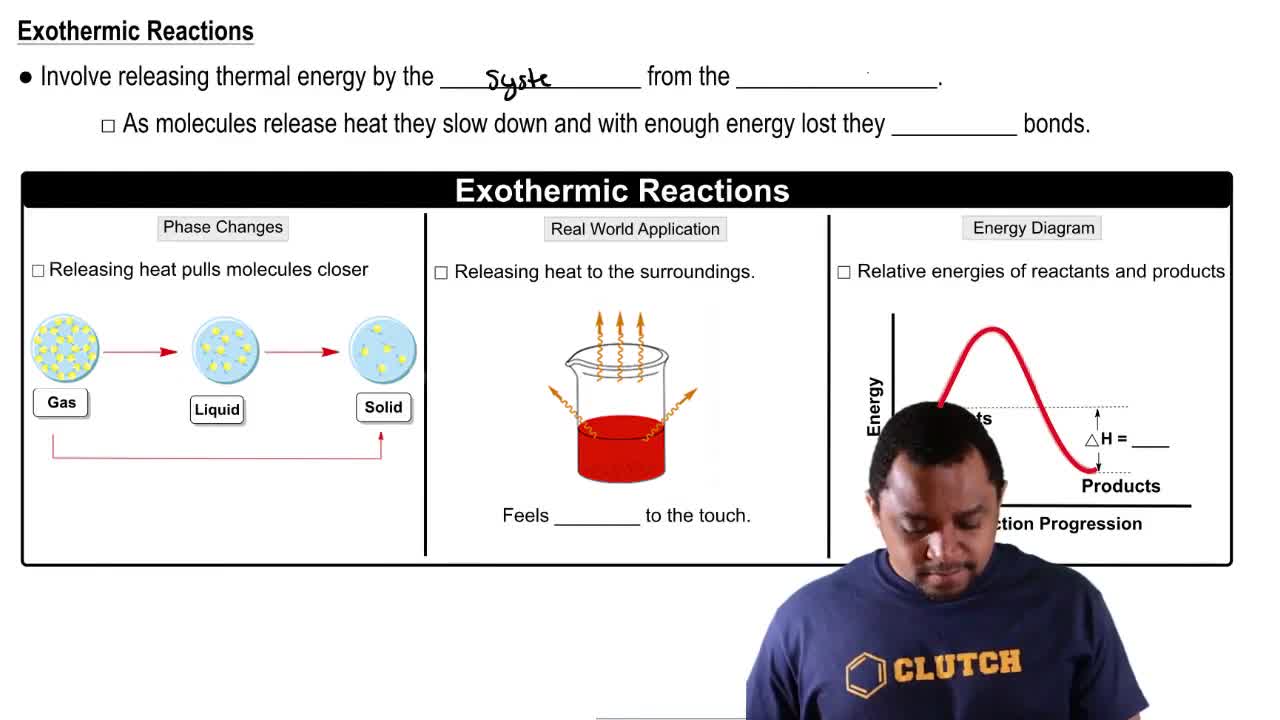
Exothermic Reactions

An exothermic reaction is one that releases energy, usually in the form of heat, to its surroundings. In the context of the Haber process, although the reaction itself is exothermic, it is conducted at high temperatures to increase the reaction rate and overcome the activation energy barrier. This is a common practice in industrial chemistry to optimize production efficiency.
추천 영상:
가이드 코스
02:38
Endothermic & Exothermic Reactions

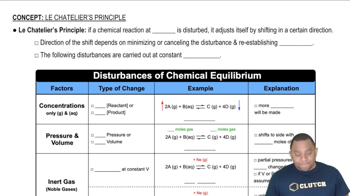
Le Chatelier's Principle

Le Chatelier's Principle states that if a dynamic equilibrium is disturbed by changing the conditions, the system will adjust to counteract the change and restore a new equilibrium. In the Haber process, high temperatures favor the formation of reactants (N2 and H2) over products (NH3), so the reaction is conducted at elevated temperatures to balance the rate of production and maintain efficiency.
추천 영상:
가이드 코스
07:32
Le Chatelier's Principle