A metal forms the fluoride MF3. Electrolysis of the molten fluo- ride by a current of 3.86 A for 16.2 minutes deposits 1.25 g of the metal. Calculate the molar mass of the metal.
Ch.19 - Electrochemistry
19장, 문제 127
A current of 11.3 A is applied to 1.25 L of a solution of 0.552 M HBr converting some of the H+ to H2(g), which bubles out of solution. What is the pH of the solution after 73 minutes?
검증된 단계별 안내1
Determine the initial moles of HBr in the solution using the formula: \( \text{moles} = \text{molarity} \times \text{volume} \).
Calculate the total charge passed through the solution using the formula: \( Q = I \times t \), where \( I \) is the current in amperes and \( t \) is the time in seconds.
Use Faraday's laws of electrolysis to find the moles of \( H^+ \) converted to \( H_2 \) gas. The number of moles of electrons is equal to \( \frac{Q}{F} \), where \( F \) is Faraday's constant (96485 C/mol).
Subtract the moles of \( H^+ \) converted to \( H_2 \) from the initial moles of \( H^+ \) to find the remaining moles of \( H^+ \) in the solution.
Calculate the new concentration of \( H^+ \) ions and use the formula \( \text{pH} = -\log[H^+] \) to find the pH of the solution.

비슷한 문제에 대한 검증된 영상 답변:
이 영상 해법은 위 문제에 도움이 된다고 튜터들이 추천한 것입니다.
영상 길이:
6m주요 개념
질문에 올바르게 답하기 위해 반드시 이해해야 하는 핵심 개념들은 다음과 같습니다.
Electrolysis
Electrolysis is a chemical process that uses an electric current to drive a non-spontaneous reaction. In this context, the current applied to the HBr solution causes the reduction of H+ ions to form hydrogen gas (H2), which escapes as bubbles. Understanding electrolysis is crucial for determining how much H+ is converted and how it affects the solution's pH.
추천 영상:
가이드 코스
The Electrolytic Cell
Molarity and Stoichiometry
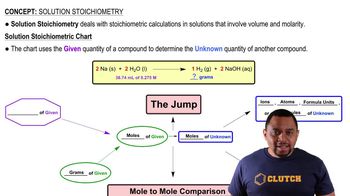
Molarity (M) is a measure of concentration defined as moles of solute per liter of solution. In this problem, the initial concentration of HBr is 0.552 M, which helps calculate the number of moles of H+ present. Stoichiometry allows us to relate the amount of H+ converted to H2 gas during electrolysis, which is essential for determining the change in pH.
추천 영상:
가이드 코스
Solution Stoichiometry
pH Calculation
pH is a logarithmic scale used to specify the acidity or basicity of a solution, calculated as pH = -log[H+]. As H+ ions are converted to H2 gas, the concentration of H+ decreases, leading to an increase in pH. Understanding how to calculate pH based on changes in H+ concentration is vital for solving the problem.
추천 영상:
가이드 코스
pH Calculation Example
관련 실천
교과서 질문
736
views
교과서 질문
A sample of impure tin of mass 0.535 g is dissolved in strong acid to give a solution of Sn2+. The solution is then titrated with a 0.0448 M solution of NO3–, which is reduced to NO(g). The equivalence point is reached upon the addition of 0.0344 L of the NO3– solution. Find the percent by mass of tin in the original sample, assuming that it contains no other reducing agents.
939
views
1
rank
교과서 질문
To what pH should you adjust a standard hydrogen electrode to get an electrode potential of -0.122 V? (Assume that the partial pressure of hydrogen gas remains at 1 atm.)
707
views
교과서 질문
An MnO2(s)/Mn2+(aq) electrode in which the pH si 10.24 is prepared. Find the [Mn2+] necessary to lower the potential of the half-cell to 0.00 V (at 25°C)
889
views