Ch.19 - Electrochemistry
Tro - Chemistry: A Molecular Approach 4th Edition
Tro4th EditionChemistry: A Molecular ApproachISBN: 9780134112831당신이 사용하는 게 아니라요?교과서 변경
19장, 문제 130

To what pH should you adjust a standard hydrogen electrode to get an electrode potential of -0.122 V? (Assume that the partial pressure of hydrogen gas remains at 1 atm.)

검증된 단계별 안내
1
Identify the Nernst equation for the hydrogen electrode, which is given by: \( E = E^0 - \frac{0.0592}{n} \log \frac{[H^+]}{P_{H_2}} \). Here, \( E^0 \) is the standard electrode potential of the hydrogen electrode, \( n \) is the number of electrons transferred in the half-reaction, \( [H^+] \) is the concentration of hydrogen ions, and \( P_{H_2} \) is the partial pressure of hydrogen gas.
Substitute the known values into the Nernst equation. Since the standard electrode potential (\( E^0 \)) for hydrogen is 0 V and the partial pressure of hydrogen gas (\( P_{H_2} \)) is given as 1 atm, the equation simplifies to: \( E = -0.0592 \log [H^+] \).
Set the electrode potential (\( E \)) to -0.122 V as given in the problem statement. Substitute this value into the simplified Nernst equation: \( -0.122 = -0.0592 \log [H^+] \).
Solve for \( [H^+] \) by isolating it on one side of the equation. This involves exponentiating both sides to remove the logarithm.
Convert the hydrogen ion concentration (\( [H^+] \)) to pH using the formula: \( pH = -\log [H^+] \).

비슷한 문제에 대한 검증된 영상 답변:

이 영상 해법은 위 문제에 도움이 된다고 튜터들이 추천한 것입니다.
영상 길이:
8m
도움이 되었나요?

주요 개념

질문에 올바르게 답하기 위해 반드시 이해해야 하는 핵심 개념들은 다음과 같습니다.

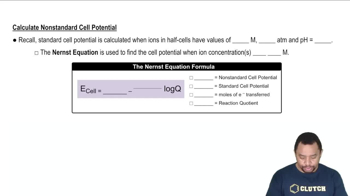
Nernst Equation

The Nernst Equation relates the electrode potential of a half-cell to the concentration of the reactants and products involved in the electrochemical reaction. It is expressed as E = E° - (RT/nF)ln(Q), where E is the electrode potential, E° is the standard electrode potential, R is the gas constant, T is the temperature in Kelvin, n is the number of moles of electrons transferred, F is Faraday's constant, and Q is the reaction quotient. This equation is essential for calculating how changes in concentration or pH affect electrode potential.
추천 영상:
가이드 코스
01:17
The Nernst Equation

Standard Hydrogen Electrode (SHE)

The Standard Hydrogen Electrode (SHE) is a reference electrode used in electrochemistry, defined as having a potential of 0 V at all temperatures. It consists of a platinum electrode in contact with 1 M H⁺ ions and hydrogen gas at 1 atm pressure. Understanding the SHE is crucial for determining the potential of other electrodes relative to this standard, particularly when adjusting conditions like pH.
추천 영상:
가이드 코스
02:25
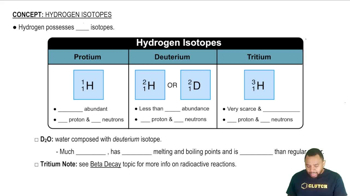
Hydrogen Isotopes

pH and Hydrogen Ion Concentration

pH is a measure of the acidity or basicity of a solution, defined as the negative logarithm of the hydrogen ion concentration (pH = -log[H⁺]). In electrochemistry, the pH of a solution directly influences the concentration of H⁺ ions, which in turn affects the electrode potential. Adjusting the pH can therefore be a method to achieve a desired electrode potential, as seen in the context of the Nernst Equation.
추천 영상:
가이드 코스
06:25
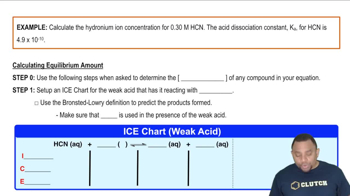
Hydronium Ion Concentration Example