Ch.19 - Electrochemistry
Tro - Chemistry: A Molecular Approach 4th Edition
Tro4th EditionChemistry: A Molecular ApproachISBN: 9780134112831당신이 사용하는 게 아니라요?교과서 변경
19장, 문제 101

A major source of sodium metal is the electrolysis of molten sodium chloride. What magnitude of current produces 1.0 kg of sodium metal in 1 hour?

검증된 단계별 안내
1
Identify the chemical reaction involved in the electrolysis of molten sodium chloride: \( 2\text{NaCl} \rightarrow 2\text{Na} + \text{Cl}_2 \).
Determine the number of moles of sodium produced: Use the molar mass of sodium (approximately 22.99 g/mol) to convert 1.0 kg of sodium to moles.
Calculate the total charge required: Since 2 moles of electrons are needed to produce 2 moles of sodium, use Faraday's constant (approximately 96485 C/mol) to find the total charge.
Relate charge to current: Use the formula \( Q = I \times t \), where \( Q \) is the total charge, \( I \) is the current, and \( t \) is the time in seconds (convert 1 hour to seconds).
Solve for the current \( I \): Rearrange the formula to \( I = \frac{Q}{t} \) and substitute the known values to find the magnitude of the current.

비슷한 문제에 대한 검증된 영상 답변:

이 영상 해법은 위 문제에 도움이 된다고 튜터들이 추천한 것입니다.
영상 길이:
2m

주요 개념

질문에 올바르게 답하기 위해 반드시 이해해야 하는 핵심 개념들은 다음과 같습니다.

Electrolysis

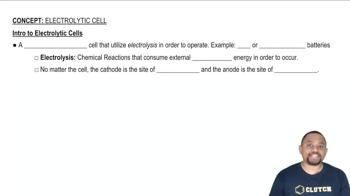
Electrolysis is a chemical process that uses electrical energy to drive a non-spontaneous reaction. In the case of sodium chloride, the process involves breaking down the compound into its constituent elements, sodium and chlorine, by passing an electric current through molten sodium chloride. This process is essential for producing sodium metal from its ionic form.
추천 영상:
가이드 코스
01:21
The Electrolytic Cell

Faraday's Laws of Electrolysis

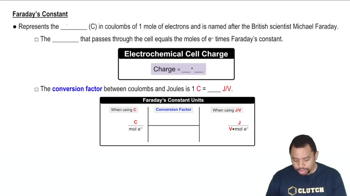
Faraday's Laws of Electrolysis quantify the relationship between the amount of substance produced at an electrode and the quantity of electric charge passed through the electrolyte. The first law states that the mass of a substance altered at an electrode is directly proportional to the total electric charge passed. This principle is crucial for calculating the current needed to produce a specific mass of sodium metal.
추천 영상:
가이드 코스
01:40
Faraday's Constant in Electrochemistry

Current and Charge Relationship

The relationship between current (I), charge (Q), and time (t) is given by the equation Q = I × t. This means that the total charge is the product of the current and the time for which it flows. Understanding this relationship is vital for determining the magnitude of current required to produce a certain mass of sodium metal in a specified time frame.
추천 영상: