Ch.19 - Electrochemistry
Tro - Chemistry: A Molecular Approach 4th Edition
Tro4th EditionChemistry: A Molecular ApproachISBN: 9780134112831당신이 사용하는 게 아니라요?교과서 변경
19장, 문제 102

What mass of aluminum metal can be produced per hour in the electrolysis of a molten aluminum salt using a current of 25 A?

검증된 단계별 안내
1
Identify the relevant electrochemical reaction: The reduction of aluminum ions to aluminum metal is represented by the half-reaction: \( \text{Al}^{3+} + 3e^- \rightarrow \text{Al} \).
Determine the number of moles of electrons required: From the half-reaction, 3 moles of electrons are needed to produce 1 mole of aluminum.
Use Faraday's Law of Electrolysis: The amount of substance produced at an electrode is directly proportional to the quantity of electricity passed through the electrolyte. The formula is \( n = \frac{I \cdot t}{n_e \cdot F} \), where \( n \) is the number of moles of aluminum, \( I \) is the current in amperes, \( t \) is the time in seconds, \( n_e \) is the number of moles of electrons, and \( F \) is Faraday's constant (approximately 96485 C/mol).
Calculate the time in seconds for one hour: Since the problem asks for the mass produced per hour, convert 1 hour into seconds (1 hour = 3600 seconds).
Calculate the mass of aluminum produced: Use the molar mass of aluminum (approximately 26.98 g/mol) to convert the moles of aluminum to grams.

주요 개념

질문에 올바르게 답하기 위해 반드시 이해해야 하는 핵심 개념들은 다음과 같습니다.

Electrolysis

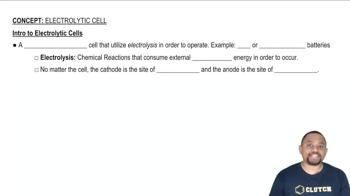
Electrolysis is a chemical process that uses electrical energy to drive a non-spontaneous reaction. In the context of aluminum production, it involves passing an electric current through molten aluminum salts, causing the aluminum ions to migrate to the cathode where they are reduced to form aluminum metal. This process is essential for extracting metals from their ores.
추천 영상:
가이드 코스
01:21
The Electrolytic Cell

Faraday's Laws of Electrolysis

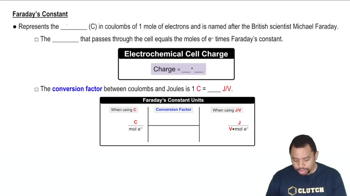
Faraday's Laws of Electrolysis quantify the relationship between the amount of substance produced at an electrode and the electric charge passed through the electrolyte. The first law states that the mass of a substance altered at an electrode is directly proportional to the quantity of electricity that passes through the electrolyte. This principle is crucial for calculating the mass of aluminum produced based on the current and time.
추천 영상:
가이드 코스
01:40
Faraday's Constant in Electrochemistry

Current and Charge

Electric current, measured in amperes (A), is the flow of electric charge. In electrolysis, the total charge (in coulombs) can be calculated by multiplying the current by the time (in seconds). Understanding this relationship is vital for determining how much aluminum can be produced in a given time frame, as it directly influences the electrolysis process.
추천 영상: