
교과서 질문
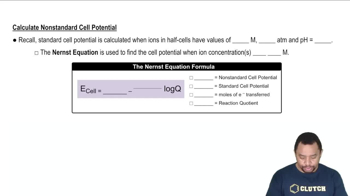
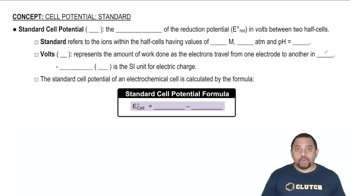
An electrochemical cell is based on these two half-reactions:
Ox: Pb(s) → Pb2+(aq, 0.10 M) + 2 e–
Red: MnO4–(aq, 1.50 M) + 4 H+(aq, 2.0 M) + 3 e– → MnO2(s) + 2 H2O(l)
Calculate the cell potential at 25 °C.
3339
views

 검증된 단계별 안내
 01:17
01:17
 01:27
01:27 01:49
01:49An electrochemical cell is based on these two half-reactions:
Ox: Pb(s) → Pb2+(aq, 0.10 M) + 2 e–
Red: MnO4–(aq, 1.50 M) + 4 H+(aq, 2.0 M) + 3 e– → MnO2(s) + 2 H2O(l)
Calculate the cell potential at 25 °C.
An electrochemical cell is based on these two half-reactions:
Ox: Sn(s) → Sn2+(aq, 2.00 M) + 2 e–
Red: ClO2(g, 0.100 atm) + e– → ClO2–(aq, 2.00 M)
Calculate the cell potential at 25 °C.
A voltaic cell consists of a Pb/Pb2+ half-cell and a Cu/Cu2+ half-cell at 25°C. The initial concentrations of Pb2+ and Cu2+ are 0.0500 M and 1.50 M, respectively. b. What is the cell potential when the concentration of Cu2+ has fallen to 0.200 M?
A voltaic cell consists of a Zn/Zn2+ half-cell and a Ni/Ni2+ half-cell at 25 °C. The initial concentrations of Ni2+ and Zn2+ are 1.50 M and 0.100 M, respectively. c. What are the concentrations of Ni2+ and Zn2+ when the cell potential falls to 0.45 V?
A voltaic cell consists of a Pb/Pb2+ half-cell and a Cu/Cu2+ half-cell at 25°C. The initial concentrations of Pb2+ and Cu2+ are 0.0500 M and 1.50 M, respectively. a. What is the initial cell potential?
A voltaic cell consists of a Zn/Zn2+ half-cell and a Ni/Ni2+ half-cell at 25 °C. The initial concentrations of Ni2+ and Zn2+ are 1.50 M and 0.100 M, respectively. a. What is the initial cell potential?