A voltaic cell employs the following redox reaction: Sn2+(aq) + Mn(s) → Sn(s) + Mn2+(aq) Calculate the cell potential at 25 °C under each set of conditions. c. [Sn2+] = 2.00 M; [Mn2+] = 0.0100 M
Ch.19 - Electrochemistry
19장, 문제 75
An electrochemical cell is based on these two half-reactions:
Ox: Pb(s) → Pb2+(aq, 0.10 M) + 2 e–
Red: MnO4–(aq, 1.50 M) + 4 H+(aq, 2.0 M) + 3 e– → MnO2(s) + 2 H2O(l)
Calculate the cell potential at 25 °C.
검증된 단계별 안내1
Identify the oxidation and reduction half-reactions. In this problem, the oxidation half-reaction is given as Pb(s) -> Pb2+ (aq) + 2 e-, and the reduction half-reaction is MnO4-(aq) + 4 H+(aq) + 3 e- -> MnO2(s) + 2 H2O(l).
Balance the number of electrons transferred in each half-reaction to combine them into a full reaction. Since the oxidation reaction produces 2 electrons and the reduction reaction consumes 3 electrons, find the least common multiple (6 electrons) and multiply the first reaction by 3 and the second reaction by 2.
Calculate the standard electrode potentials for each half-reaction if not given. Use standard reduction potential tables to find the values for Pb2+/Pb and MnO4-/MnO2 in their respective conditions.
Use the Nernst equation to calculate the cell potential under non-standard conditions. The Nernst equation is E = E° - (RT/nF) * ln(Q), where E° is the standard cell potential, R is the gas constant, T is the temperature in Kelvin, n is the number of moles of electrons transferred, F is the Faraday constant, and Q is the reaction quotient.
Calculate the reaction quotient Q from the given concentrations of the reactants and products. For the reaction quotient, use the formula Q = ([products]^stoichiometric coefficients) / ([reactants]^stoichiometric coefficients), considering the concentrations given in the problem.

비슷한 문제에 대한 검증된 영상 답변:
이 영상 해법은 위 문제에 도움이 된다고 튜터들이 추천한 것입니다.
영상 길이:
7m도움이 되었나요?
주요 개념
질문에 올바르게 답하기 위해 반드시 이해해야 하는 핵심 개념들은 다음과 같습니다.
Electrochemical Cells
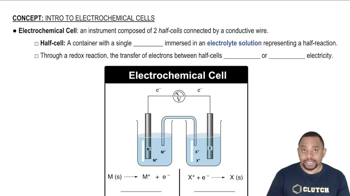
Electrochemical cells consist of two half-cells where oxidation and reduction reactions occur. The oxidation half-cell involves the loss of electrons, while the reduction half-cell involves the gain of electrons. The cell potential, or electromotive force (EMF), is generated due to the difference in potential energy between the two half-reactions, driving the flow of electrons through an external circuit.
추천 영상:
가이드 코스
Electrochemical Cells
Nernst Equation
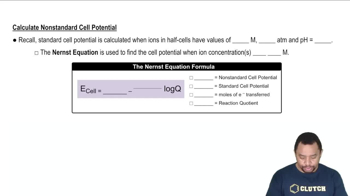
The Nernst equation relates the cell potential to the concentrations of the reactants and products involved in the half-reactions. It is expressed as E = E° - (RT/nF) ln(Q), where E° is the standard cell potential, R is the gas constant, T is the temperature in Kelvin, n is the number of moles of electrons transferred, F is Faraday's constant, and Q is the reaction quotient. This equation allows for the calculation of the cell potential under non-standard conditions.
추천 영상:
가이드 코스
The Nernst Equation
Standard Reduction Potentials
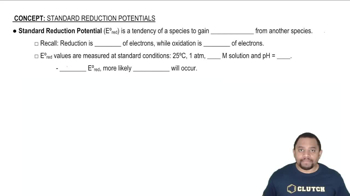
Standard reduction potentials (E°) are measured under standard conditions (1 M concentration, 1 atm pressure, and 25 °C) and indicate the tendency of a species to gain electrons. Each half-reaction has a specific E° value, which can be found in tables. The overall cell potential can be calculated by subtracting the standard reduction potential of the oxidation half-reaction from that of the reduction half-reaction, providing insight into the spontaneity of the electrochemical reaction.
추천 영상:
가이드 코스
Standard Reduction Potentials
관련 실천
교과서 질문
3481
views
1
rank
교과서 질문
An electrochemical cell is based on these two half-reactions:
Ox: Sn(s) → Sn2+(aq, 2.00 M) + 2 e–
Red: ClO2(g, 0.100 atm) + e– → ClO2–(aq, 2.00 M)
Calculate the cell potential at 25 °C.
2511
views
교과서 질문
A voltaic cell consists of a Zn/Zn2+ half-cell and a Ni/Ni2+ half-cell at 25 °C. The initial concentrations of Ni2+ and Zn2+ are 1.50 M and 0.100 M, respectively. b. What is the cell potential when the concentration of Ni2+ has fallen to 0.500 M?
2196
views
교과서 질문
A voltaic cell consists of a Zn/Zn2+ half-cell and a Ni/Ni2+ half-cell at 25 °C. The initial concentrations of Ni2+ and Zn2+ are 1.50 M and 0.100 M, respectively. a. What is the initial cell potential?
588
views