A voltaic cell employs the following redox reaction: Sn2+(aq) + Mn(s) → Sn(s) + Mn2+(aq) Calculate the cell potential at 25 °C under each set of conditions. c. [Sn2+] = 2.00 M; [Mn2+] = 0.0100 M
Ch.19 - Electrochemistry
19장, 문제 74
A voltaic cell employs the redox reaction: 2 Fe3+(aq) + 3 Mg(s) → 2 Fe(s) + 3 Mg2+(aq). Calculate the cell potential at 25 °C under each set of conditions. a. standard conditions. b. [Fe3+] = 1.0 × 10^-3 M; [Mg2+] = 2.50 M. c. [Fe3+] = 2.00 M; [Mg2+] = 1.5 × 10^-3 M.
검증된 단계별 안내1
insert step 1: Identify the half-reactions and their standard reduction potentials.
insert step 2: Calculate the standard cell potential (E°cell) using the standard reduction potentials.
insert step 3: Use the Nernst equation to calculate the cell potential under non-standard conditions.
insert step 4: For part b, substitute the given concentrations into the Nernst equation and solve for the cell potential.
insert step 5: For part c, substitute the given concentrations into the Nernst equation and solve for the cell potential.
주요 개념
질문에 올바르게 답하기 위해 반드시 이해해야 하는 핵심 개념들은 다음과 같습니다.
Redox Reactions
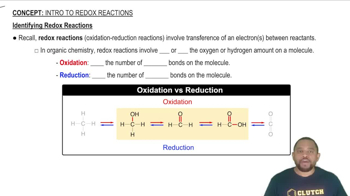
Redox reactions involve the transfer of electrons between two species, where one species is oxidized (loses electrons) and the other is reduced (gains electrons). In the given reaction, Fe3+ is reduced to Fe, while Mg is oxidized to Mg2+. Understanding the oxidation states and the flow of electrons is crucial for analyzing the cell's operation.
추천 영상:
가이드 코스
Identifying Redox Reactions
Cell Potential (E°)
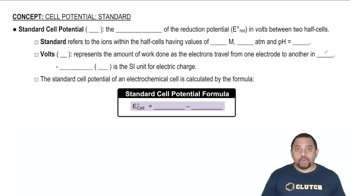
The cell potential, or electromotive force (EMF), is a measure of the voltage generated by a voltaic cell under specific conditions. It can be calculated using standard reduction potentials and the Nernst equation, which accounts for concentration changes. The standard cell potential is determined under standard conditions (1 M concentration, 1 atm pressure, and 25 °C).
추천 영상:
가이드 코스
Standard Cell Potential
Nernst Equation
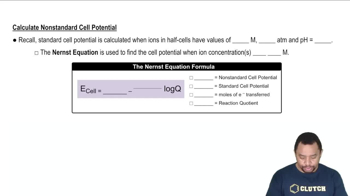
The Nernst equation relates the cell potential to the concentrations of the reactants and products in a redox reaction. It is expressed as E = E° - (RT/nF) ln(Q), where Q is the reaction quotient. This equation allows for the calculation of cell potential under non-standard conditions, making it essential for solving parts b and c of the question.
추천 영상:
가이드 코스
The Nernst Equation
관련 실천
교과서 질문
3481
views
1
rank
교과서 질문
An electrochemical cell is based on these two half-reactions:
Ox: Pb(s) → Pb2+(aq, 0.10 M) + 2 e–
Red: MnO4–(aq, 1.50 M) + 4 H+(aq, 2.0 M) + 3 e– → MnO2(s) + 2 H2O(l)
Calculate the cell potential at 25 °C.
3339
views
교과서 질문
An electrochemical cell is based on these two half-reactions:
Ox: Sn(s) → Sn2+(aq, 2.00 M) + 2 e–
Red: ClO2(g, 0.100 atm) + e– → ClO2–(aq, 2.00 M)
Calculate the cell potential at 25 °C.
2511
views
교과서 질문
A voltaic cell consists of a Zn/Zn2+ half-cell and a Ni/Ni2+ half-cell at 25 °C. The initial concentrations of Ni2+ and Zn2+ are 1.50 M and 0.100 M, respectively. a. What is the initial cell potential?
588
views