Ch.19 - Electrochemistry
Tro - Chemistry: A Molecular Approach 4th Edition
Tro4th EditionChemistry: A Molecular ApproachISBN: 9780134112831당신이 사용하는 게 아니라요?교과서 변경
19장, 문제 54

Determine whether or not each redox reaction occurs spontaneously in the forward direction.
a. Ca2+(aq) + Zn(s) → Ca(s) + Zn2+(aq)
b. 2 Ag+(aq) + Ni(s) → 2 Ag(s) + Ni2+(aq)
c. Fe(s) + Mn2+(aq) → Fe2+(aq) + Mn(s)
d. 2 Al(s) + 3 Pb2+(aq) → 2 Al3+(aq) + 3 Pb(s)

검증된 단계별 안내
1
Identify the oxidation and reduction half-reactions. In this case, silver ions (Ag+) are reduced to silver metal (Ag), and nickel metal (Ni) is oxidized to nickel ions (Ni2+).
Write the half-reactions separately. For reduction: Ag+ + e- → Ag. For oxidation: Ni → Ni2+ + 2e-.
Check the standard reduction potentials for each half-reaction. The standard reduction potential for Ag+ to Ag is +0.80 V, and for Ni to Ni2+ it is -0.25 V.
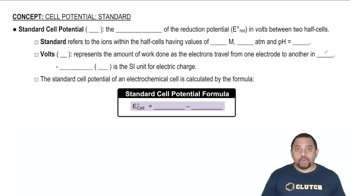
Calculate the standard cell potential (E°cell) for the reaction by subtracting the standard reduction potential of the anode (oxidation) from the cathode (reduction). E°cell = E°cathode - E°anode.
Determine the spontaneity of the reaction. If E°cell is positive, the reaction is spontaneous in the forward direction; if it is negative, the reaction is non-spontaneous.

비슷한 문제에 대한 검증된 영상 답변:

이 영상 해법은 위 문제에 도움이 된다고 튜터들이 추천한 것입니다.
영상 길이:
4m
도움이 되었나요?

주요 개념

질문에 올바르게 답하기 위해 반드시 이해해야 하는 핵심 개념들은 다음과 같습니다.

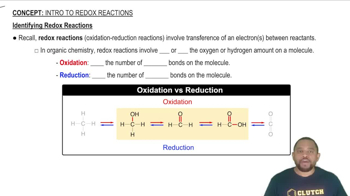
Redox Reactions

Redox reactions, or reduction-oxidation reactions, involve the transfer of electrons between two species. In these reactions, one species is oxidized (loses electrons) while the other is reduced (gains electrons). Understanding the oxidation states of the elements involved is crucial for identifying which species undergo these changes.
추천 영상:
가이드 코스
03:12
Identifying Redox Reactions

Standard Electrode Potentials

Standard electrode potentials (E°) are measured values that indicate the tendency of a species to be reduced. Each half-reaction has a specific E° value, and the overall spontaneity of a redox reaction can be determined by calculating the cell potential (E°cell) using the formula E°cell = E°(reduction) - E°(oxidation). A positive E°cell indicates that the reaction is spontaneous in the forward direction.
추천 영상:
가이드 코스
01:27
Standard Cell Potential

Spontaneity of Reactions

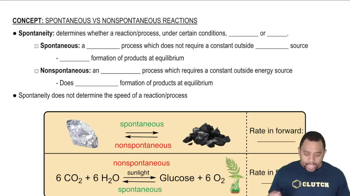
The spontaneity of a reaction refers to its ability to occur without external intervention. In the context of redox reactions, spontaneity can be assessed through Gibbs free energy (ΔG). A negative ΔG corresponds to a spontaneous reaction, which can be related to the cell potential; specifically, ΔG = -nFE°cell, where n is the number of moles of electrons transferred and F is Faraday's constant.
추천 영상:
가이드 코스
04:20
Spontaneity of Processes