Silver can be electroplated at the cathode of an electrolysis cell by the half-reaction: Ag+(aq) + e– → Ag(s) What mass of silver would plate onto the cathode if a current of 6.8 A flowed through the cell for 72 min?
Ch.19 - Electrochemistry
19장, 문제 98
How can one sketch an electrolysis cell that electroplates nickel onto other metal surfaces, labeling the anode and cathode and indicating the reactions that occur at each?
검증된 단계별 안내1
Identify the components of the electrolysis cell: anode, cathode, electrolyte solution, and power source.
Label the anode as the positive electrode where oxidation occurs, and the cathode as the negative electrode where reduction occurs.
Indicate that the anode is made of nickel, which will dissolve into the electrolyte solution as Ni^2+ ions.
Label the cathode as the metal surface to be plated with nickel, where Ni^2+ ions from the solution will gain electrons and deposit as solid nickel.
Write the half-reactions: at the anode, \( \text{Ni (s)} \rightarrow \text{Ni}^{2+} (aq) + 2e^- \); at the cathode, \( \text{Ni}^{2+} (aq) + 2e^- \rightarrow \text{Ni (s)} \).
주요 개념
질문에 올바르게 답하기 위해 반드시 이해해야 하는 핵심 개념들은 다음과 같습니다.
Electrolysis
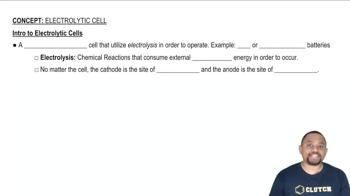
Electrolysis is a chemical process that uses electrical energy to drive a non-spontaneous reaction. In an electrolysis cell, an external power source applies voltage to facilitate the movement of ions in an electrolyte solution, leading to chemical changes at the electrodes. This process is fundamental in electroplating, where metal ions are deposited onto a surface.
추천 영상:
가이드 코스
The Electrolytic Cell
Anode and Cathode
In an electrolysis cell, the anode is the electrode where oxidation occurs, meaning it loses electrons, while the cathode is where reduction takes place, gaining electrons. For nickel electroplating, the anode typically consists of nickel metal, which dissolves into the solution as nickel ions, while the cathode is the surface being plated, where nickel ions are reduced and deposited.
추천 영상:
가이드 코스
Electrolytic Cell Components Example
Half-Reactions
Half-reactions are the individual oxidation and reduction reactions that occur at the anode and cathode, respectively. In the context of nickel electroplating, the half-reaction at the anode involves the oxidation of nickel metal to nickel ions, while the cathode reaction involves the reduction of nickel ions back to solid nickel. Understanding these half-reactions is crucial for sketching the electrolysis cell accurately.
추천 영상:
가이드 코스
Redox Half Reactions Example
관련 실천
교과서 질문
2188
views
교과서 질문
Make a sketch of an electrolysis cell that electroplates copper onto other metal surfaces. Label the anode and the cathode and indicate the reactions that occur at each.
887
views
교과서 질문
A major source of sodium metal is the electrolysis of molten sodium chloride. What magnitude of current produces 1.0 kg of sodium metal in 1 hour?
1055
views
교과서 질문
Write equations for the half-reactions that occur at the anode and cathode for the electrolysis of each aqueous solution. b. KCl(aq) c. CuBr2(aq)
교과서 질문
Write equations for the half-reactions that occur at the anode and cathode for the electrolysis of each aqueous solution. a. Ni(NO3)2(aq)
3029
views