Ch.2 - Atoms & Elements
Tro - Chemistry: A Molecular Approach 4th Edition
Tro4th EditionChemistry: A Molecular ApproachISBN: 9780134112831당신이 사용하는 게 아니라요?교과서 변경
2장, 문제 60c

Predict the charge of the ion formed by each element. c. F

검증된 단계별 안내
1
Step 1: Identify the element. In this case, the element is Fluorine (F).
Step 2: Determine the number of valence electrons for the element. Fluorine is in group 17 (also known as 7A) of the periodic table, so it has 7 valence electrons.
Step 3: Recall that atoms tend to gain, lose, or share electrons to achieve a stable electron configuration, often having 8 electrons in their outermost shell (the octet rule).
Step 4: Determine how many electrons the element needs to gain or lose to achieve a stable electron configuration. In the case of Fluorine, it needs to gain 1 electron to have a full outer shell of 8 electrons.
Step 5: The charge of the ion is determined by the number of electrons gained or lost. If an atom gains electrons, it becomes negatively charged, and if it loses electrons, it becomes positively charged. Since Fluorine gains 1 electron, the ion it forms will have a charge of -1.

비슷한 문제에 대한 검증된 영상 답변:

이 영상 해법은 위 문제에 도움이 된다고 튜터들이 추천한 것입니다.
영상 길이:
1m
도움이 되었나요?

주요 개념

질문에 올바르게 답하기 위해 반드시 이해해야 하는 핵심 개념들은 다음과 같습니다.

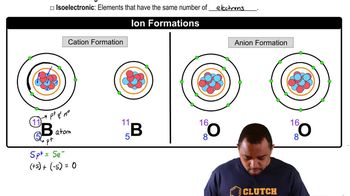
Ion Formation

Ions are charged particles that form when atoms gain or lose electrons. Elements tend to form ions to achieve a stable electron configuration, often resembling the nearest noble gas. Metals typically lose electrons to form cations, while nonmetals gain electrons to form anions.
추천 영상:

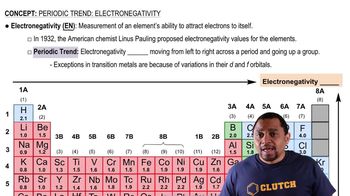
Electronegativity

Electronegativity is a measure of an atom's ability to attract and hold onto electrons. In the context of ion formation, elements with high electronegativity, like fluorine, are more likely to gain electrons and form negative ions (anions). This property helps predict the charge of the ion an element will form.
추천 영상:
가이드 코스
02:10
Electronegativity Trends

Fluorine's Charge

Fluorine is a highly electronegative nonmetal that typically gains one electron to achieve a full outer shell, resulting in a charge of -1. This means that when fluorine forms an ion, it becomes F-, indicating it has gained an electron and carries a negative charge.
추천 영상: